


Policy Compass is a regulatory intelligence platform for UK energy: continuous monitoring, cited research and deadline tracking, contextualised to your business and your role.
TL;DR
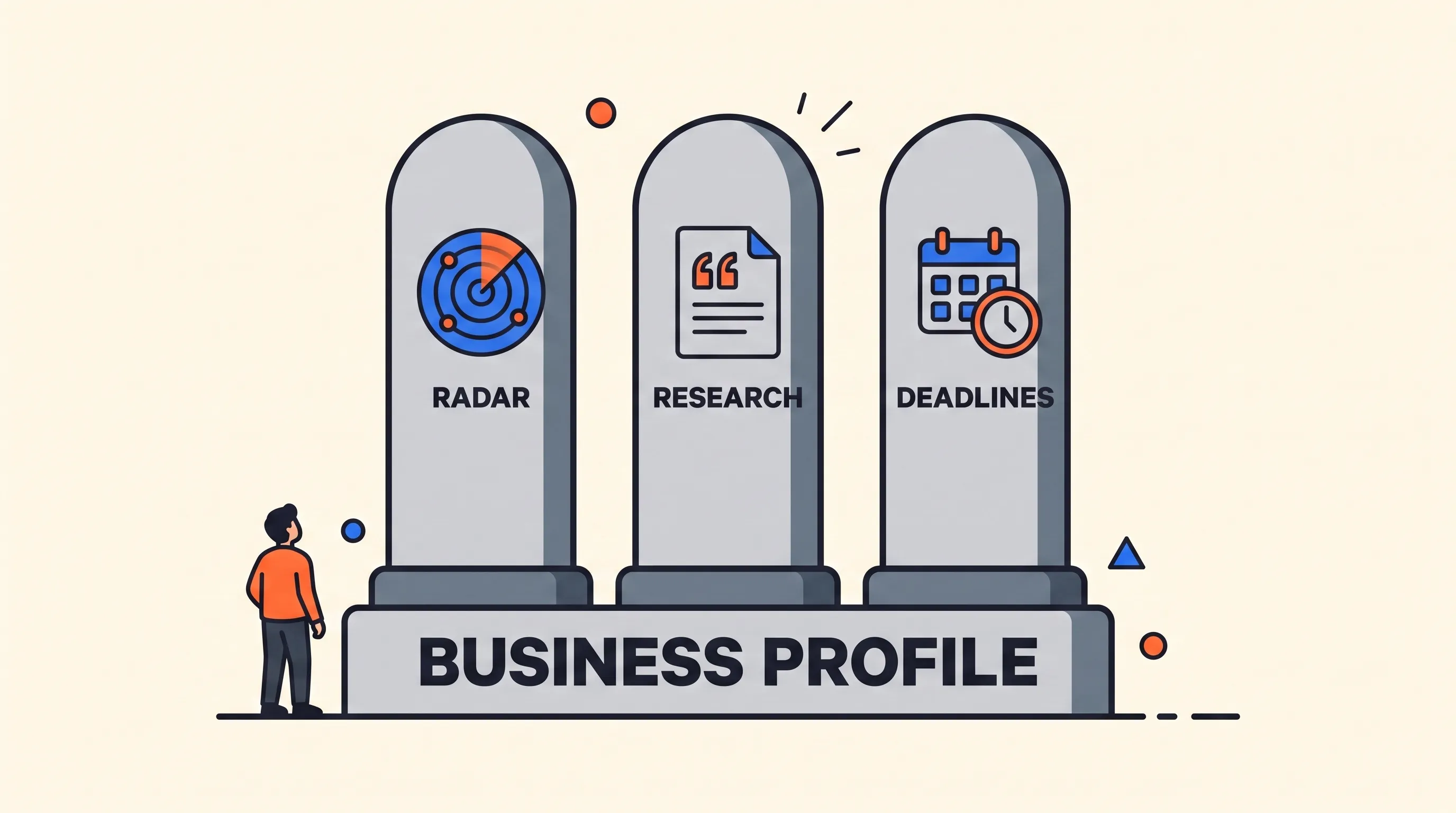
- What it is: a single regulatory intelligence platform for UK energy - Radar, Research and Deadlines in one place, instead of a stack of alerts, newsletters and manual monitoring.
- What it does: it watches across UK energy’s regulators and industry codes around the clock, gives each change a relevance score from 1 to 10 for your business and your role, and answers research questions grounded only in authoritative sources - every claim cited.
- What makes it intelligence: it knows your business and your role, so the same regulation gets a different answer for the person on the codes than for the colleague on retail.
- What it is not: not a compliance tool, not an analyst newsletter, and not a general-purpose AI assistant like ChatGPT (or Claude, Gemini or Perplexity).
- Who it is for: UK energy regulation professionals - suppliers, consultancies, flexibility providers and network operators - who already know the domain and need to work faster.
What is Policy Compass?
Policy Compass is a regulatory intelligence platform for UK energy businesses. The one-line version we use internally: think of it as a standing regulatory analyst that already knows your business - a system that watches across UK energy’s regulators and industry codes for you and tells you what matters and what it means before you would otherwise know to look.
The pace of regulatory change is relentless: Ofgem (opens in new tab) decisions, DESNZ (opens in new tab) consultations, industry code modifications, price-control reviews. Keeping on top of it is a full-time job, and the teams doing it are stretched thin. Policy Compass does the monitoring, filtering and first-pass interpretation - so the expensive expert time goes back to judgement.
What “regulatory intelligence” actually means (and what it doesn’t)
Regulatory intelligence is knowing three things, continuously: what is changing across the bodies that govern your market, what it means for your specific business, and what you need to do about it. Not a quarterly report. A live picture.
Crucially, it is not compliance software. Compliance tools assess and score whether you are meeting your obligations; regulatory intelligence sits earlier - it tells you what the obligations are and how they are changing. Policy Compass never tells you whether you are compliant; that judgement is yours. It is the continuous, source-grounded, business-contextualised layer that search, generic AI and analyst newsletters each miss on their own.
The three things Policy Compass does
Radar - continuous monitoring
Radar reads across UK energy’s regulators and industry codes at source, around the clock. That is a job in itself: each code publishes its change record on its own site, in its own format. Every consultation, decision and code modification arrives with a relevance score from 1 to 10 for how much it matters to your business and your role, with a line on why. Not “here is everything” - here is what to look at, and what to ignore. The day’s signals that clear your priority threshold land in your inbox as a digest. That continuous coverage is really insurance against the change you never see coming - the consultation window that closes before you notice it.
Research - answers you can trust
Ask it any regulatory research question. Research hands back a cited answer drawn only from authoritative sources like Ofgem (opens in new tab), DESNZ (opens in new tab) and the industry codes such as the Retail Energy Code (opens in new tab) - never the open web, forums or generic AI training data. Every claim links to its source, so you can verify it and put it in a board paper.
Deadlines - nothing slips
Consultation response windows, code-modification votes and regulatory milestones are extracted automatically and tracked, with reminders before they are due. And when a response is due, you can draft the consultation itself from your house ethos rather than starting from a blank page.
Everything runs on a persistent business profile that captures who you are - licence type, customer segments, market participation, geography - and the specific role you play on the team. That is the part that makes it intelligence rather than a feed. Internally we call this scaffolding the Regulatory Harness - the authoritative source base, your business context and your role context wrapped around the model.
Same regulation, different answer. Take heat networks: under the Energy Act 2023, Ofgem became the regulator for heat networks in Great Britain, with the first authorisation rules taking effect on 27 January 2026 (opens in new tab). For a heat-network operator that scores a 9 - new obligations, a registration window, guaranteed standards on the way. For a pure electricity retailer it is close to a 1 - worth noting, not worth acting on. And inside a single business it splits again by role: a change that scores a 9 for the person on the codes can be a 3 for the colleague on retail. Policy Compass makes that call for every signal, for every profile, automatically.
Who Policy Compass is for
It is built for UK energy regulation professionals - people who already know the domain and need better tooling, not an explainer:
- Energy suppliers with regulatory teams who cannot keep up with the volume of change.
- Energy consultancies managing multiple client portfolios, each with different regulatory exposure.
- Flexibility providers and aggregators navigating balancing, capacity-market and grid-code rules that are still being written.
- Network operators tracking price controls, licence obligations and code modifications.
It is enterprise B2B for the practitioner. It is not a tool for SME business owners, and it does not try to teach you regulation you already know better than we do.
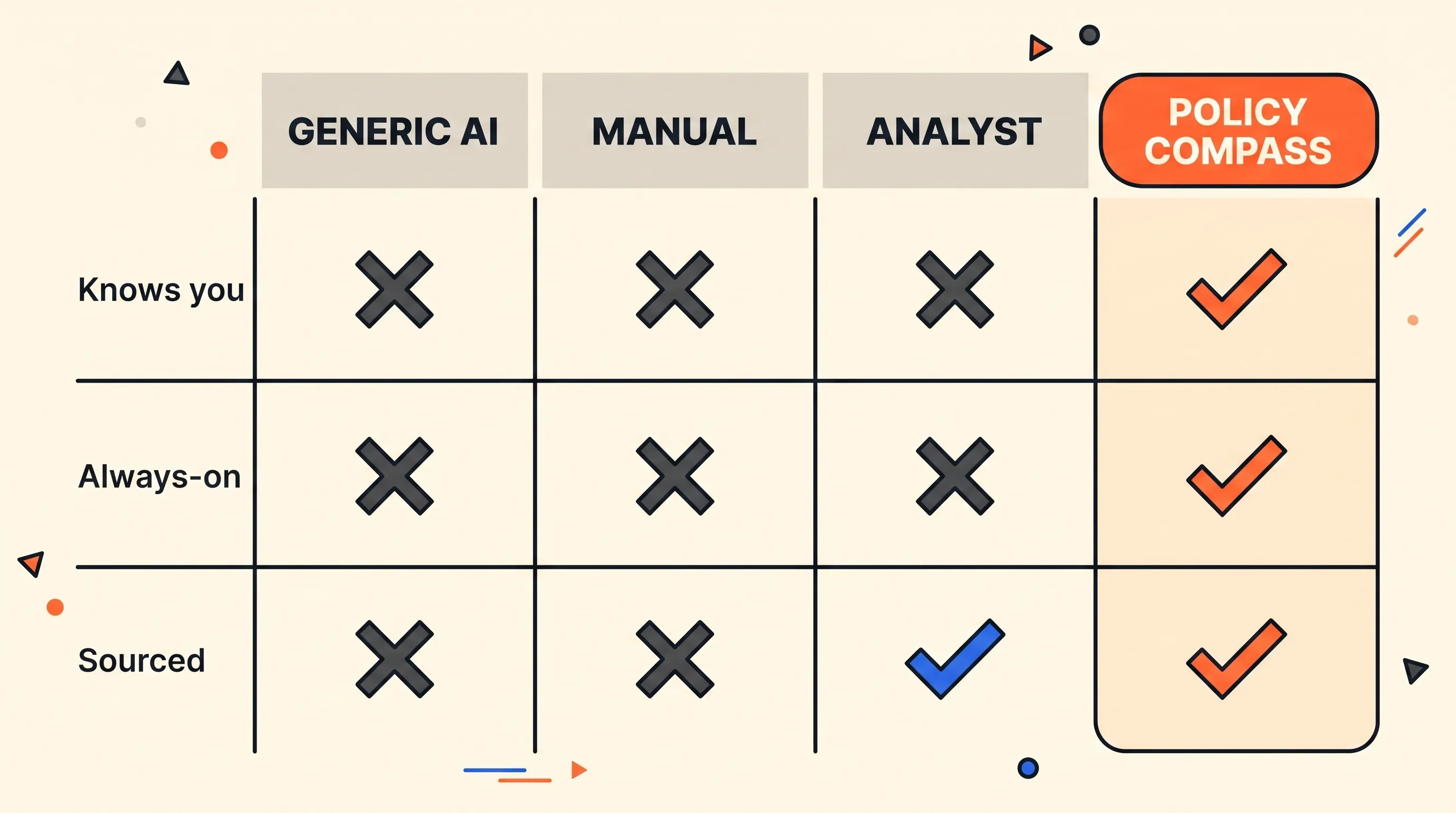
How a regulatory intelligence platform compares to ChatGPT, manual monitoring and analyst reports
The question isn’t whether the usual approaches work - people run whole regulatory functions on them. It’s what each one structurally can’t do.
| What matters | Generic AI (ChatGPT, Claude, etc.) | Manual monitoring | Analyst publications | Policy Compass |
|---|---|---|---|---|
| Knows your business | No | In someone’s head | No | Persistent business profile |
| Knows your role | No | No | No | Role-aware interpretation |
| Continuous | Answers only when asked | No | Periodic | Radar, around the clock |
| Source grounding | Open web; can invent sources | Authoritative, if you have the hours | Authoritative | Authoritative sources only, every claim cited |
| What you actually get | A plausible answer | Slow and never complete | What happened, generically | What is changing, what it means for you, and what to do |
Policy Compass is the layer those approaches leave open: continuous, restricted to authoritative sources, and contextualised to your business and your role. If a general-purpose assistant is your current tool for this, we go deeper on that comparison in Policy Compass vs ChatGPT. And if it is an analyst subscription you are weighing this against, we lay out the alternatives in full.
What Policy Compass is not
Being precise matters, because the words are loaded. It is not a compliance tool - it does not assess, score or certify whether you are compliant, audit you, or rate your “regulatory posture”. It tracks, flags and interprets; the decisions stay with you. And it is not a replacement for expertise - it is a force multiplier for it. Like any AI tool, it can be wrong. That is exactly why every answer cites its source, and why the final call stays with the people who know the regulation better than we do.
The bottom line
Most tools in this space either show you everything and leave you to triage it, or tell you what happened, generically and after the fact. Policy Compass is the layer in between: it knows your business and your role, so it surfaces which of this week’s changes are actually yours - and what they mean. If you already know the regulation and need to cover more ground than your headcount allows, that is the problem it exists to solve.
See it on your own desk
Request a trial and we set your team up - profile built, ready to go. From there Radar is your own agent on the market: around the clock it reads across UK energy’s regulators and industry codes and flags the handful of changes that matter to you, rated and explained by role - often before you’d have thought to look. Research answers the rest, cited. A free trial, full access - put it on your own regulatory patch and judge it there.