


TL;DR
- Why we built it: we needed it ourselves, while building an energy switching platform.
- The problem: the monitoring, reading and cross-referencing of regulatory change was crowding out the time that should have gone to interpretation and decisions.
- What we did: built rough internal automations, validated the problem with energy consultancies and flexibility providers, then turned it into a product.
- What it is: regulatory intelligence for UK energy - monitoring across the regulators and industry codes, contextualised to your specific business.
We didn’t set out to build a regulatory intelligence platform.
In mid-2025, my co-founder Lu (opens in new tab) and I pivoted Meet George from domestic to non-domestic business energy switching. We’d been building in the domestic space and decided to go after the harder, more interesting problem - helping businesses switch energy suppliers without the phone calls and embedded commissions that define the broker model.
What we didn’t appreciate was just how different the non-domestic energy market would be.
Drowning in regulatory information
Within the first week of pivoting to non-domestic, I signed up for newsletters from Ofgem (opens in new tab), DESNZ (opens in new tab), and a handful of other regulatory bodies. I figured I’d stay on top of what was happening in the sector so I could steer what we needed to build.
Within that first week, I had about 50 emails.
Consultations. Decisions. Open letters. Code modifications. Policy updates. Discussion papers. Each one potentially relevant, most of them impenetrable unless you already understood the context they sat within. And I didn’t - not yet.
The non-domestic energy market is fundamentally more complex than the domestic side, at least from a TPI perspective. We had to understand how energy switching actually works for businesses, what suppliers want, how the whole market interplays - the codes, the settlement processes, the licence conditions. And we had to understand what regulatory changes were coming that could affect what we were building.
I knew almost immediately that I needed to filter this. There was no way to read everything manually and still have time to actually build the product.
Building tools to survive
Lu was heads-down building the switching platform itself, so I took it on myself to figure out the regulatory landscape. Not because I had any particular expertise in energy regulation - I didn’t - but because someone had to understand the sector well enough to steer what we built, spot the risks coming our way, and find the opportunities.
So I started building automations. Nothing sophisticated - just simple workflows that would pull in what was being published each day and each week from the regulatory bodies we were following. We were following them mainly because they were the obvious ones - Ofgem (opens in new tab), DESNZ (opens in new tab), Elexon (opens in new tab), RECCo (opens in new tab). We didn’t necessarily know they were the ones we needed to follow for what we were building. We were learning as we went.
Then I added a layer on top: AI analysis that understood who we were and what we were building, so it could give some guidance on what was relevant and what wasn’t. Filter the signal from the noise. These were rough, early tools - nothing like what Policy Compass is today - but they worked well enough to stop us from drowning.
And the more we used them, the more we learned. The more we learned, the more we realised how much we needed to know. It was a compounding problem - every new thing we understood revealed three more things we didn’t.
The perfect storm
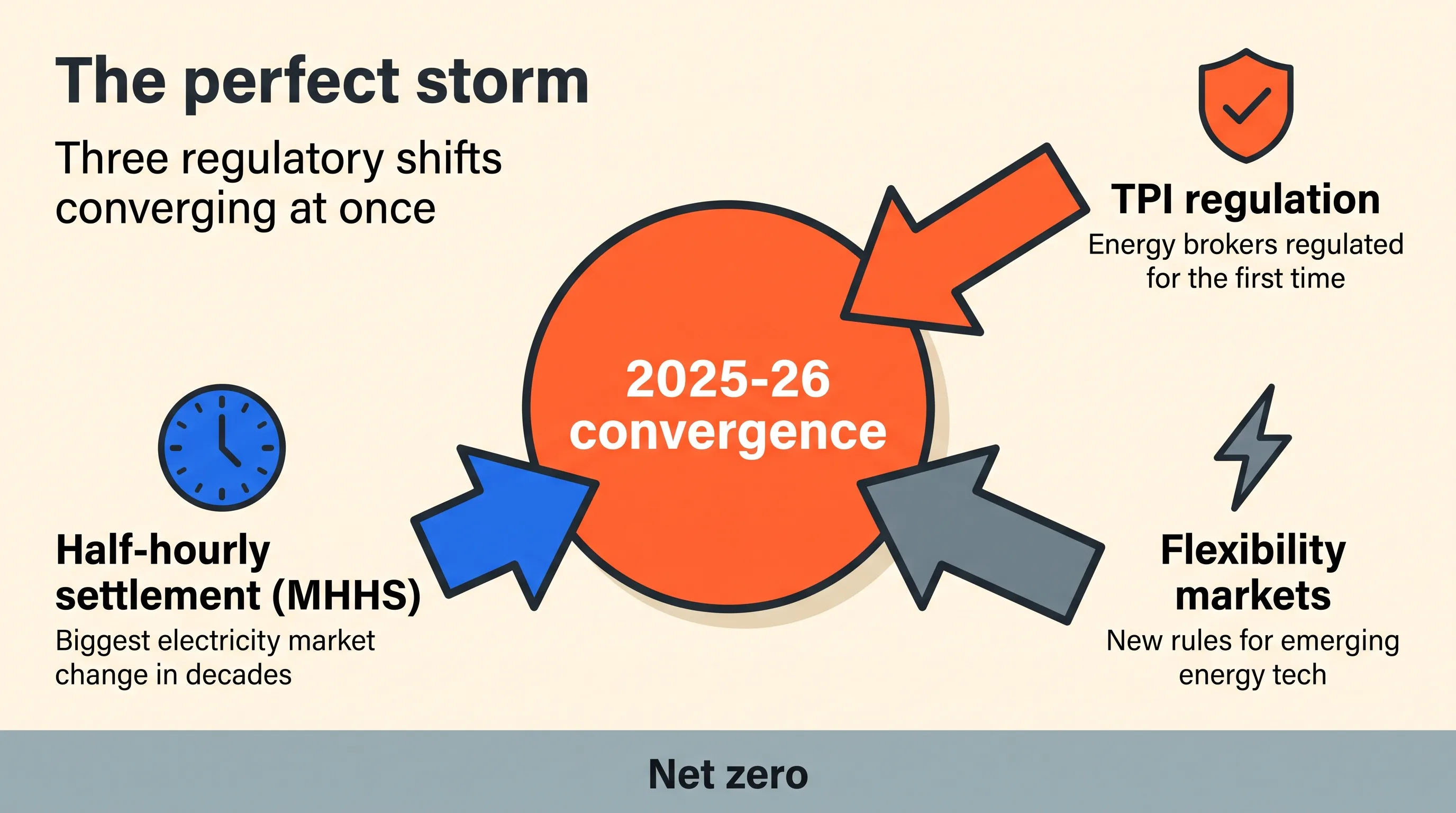
Three major regulatory shifts were converging at once - TPI regulation, market-wide half-hourly settlement and emerging flexibility markets - and we’d entered the market right in the middle of them. That convergence is what made this period so intense.
Third-party intermediaries were about to become regulated (opens in new tab). For us, as a company building a switching platform, this was directly relevant - we needed to follow it, understand what was coming, know how it would affect us, and plan accordingly.
Market-wide half-hourly settlement was rolling out - one of the biggest market changes in decades, and everything downstream of it moved at once.
Flexibility markets were emerging. Net zero targets were driving network upgrades. Every month seemed to bring new consultations, new proposals, new decisions that cascaded through the sector.
Trying to stay across all of this while simultaneously building a product was genuinely challenging. And we knew that if we could understand the sector better, we’d be able to find the niche opportunities - the areas where the market was moving that others hadn’t spotted yet. So the regulatory intelligence wasn’t just defensive. It was strategic.
The realisation
The realisation was simple: if two technical founders could barely keep up with regulatory change, the specialists doing it full-time had to be struggling more. At some point - I can’t pinpoint the exact moment - we started to think: if we’re struggling with this, and we have the technical skills to build automations and AI workflows, what about the people who don’t?
How were energy suppliers staying on top of this? How were consultancies managing this across multiple clients? How were flexibility providers - often small teams where the same people managing trading and operations are also responsible for tracking regulatory change - keeping up with rules that were literally being written in real time?
We didn’t know the answer. But we had a hypothesis that the tooling available wasn’t good enough. That there was a gap between the volume of regulatory output and people’s ability to process it, and that gap was only growing.
From internal tool to product
We put out a very rough version of Policy Compass in late October 2025. And I mean rough - we hadn’t done much work on it beyond the core concept. We mostly wanted to see if people would sign up.
Hardly anyone did. We didn’t do much marketing - it was more of a “throw it out there and see what happens” exercise. In hindsight, the product simply wasn’t good enough yet, and we hadn’t earned any attention.
In mid-January 2026, we decided to give it a proper go. Lu had a technical breakthrough that made the platform significantly stronger, and the quality of what we could deliver jumped noticeably.
Around the same time, I’d posted on LinkedIn (opens in new tab) about a specific regulatory proposal I’d come across - something fairly nuanced that I’d learned about. What surprised me was who engaged with it. Regulatory professionals. People working in energy consultancies, supplier regulatory teams, people who lived and breathed this stuff. They were commenting with genuine expertise, and they were interested in the topic.
I used that as an opportunity to reach out. Would you be interested in having a look at what we’re building? A few said yes. And that led to our first proper design partners.
What surprised us
Three things surprised us once design partners started using it: the problem was real even for full-time experts, people genuinely wanted to try it, and it got used every day.
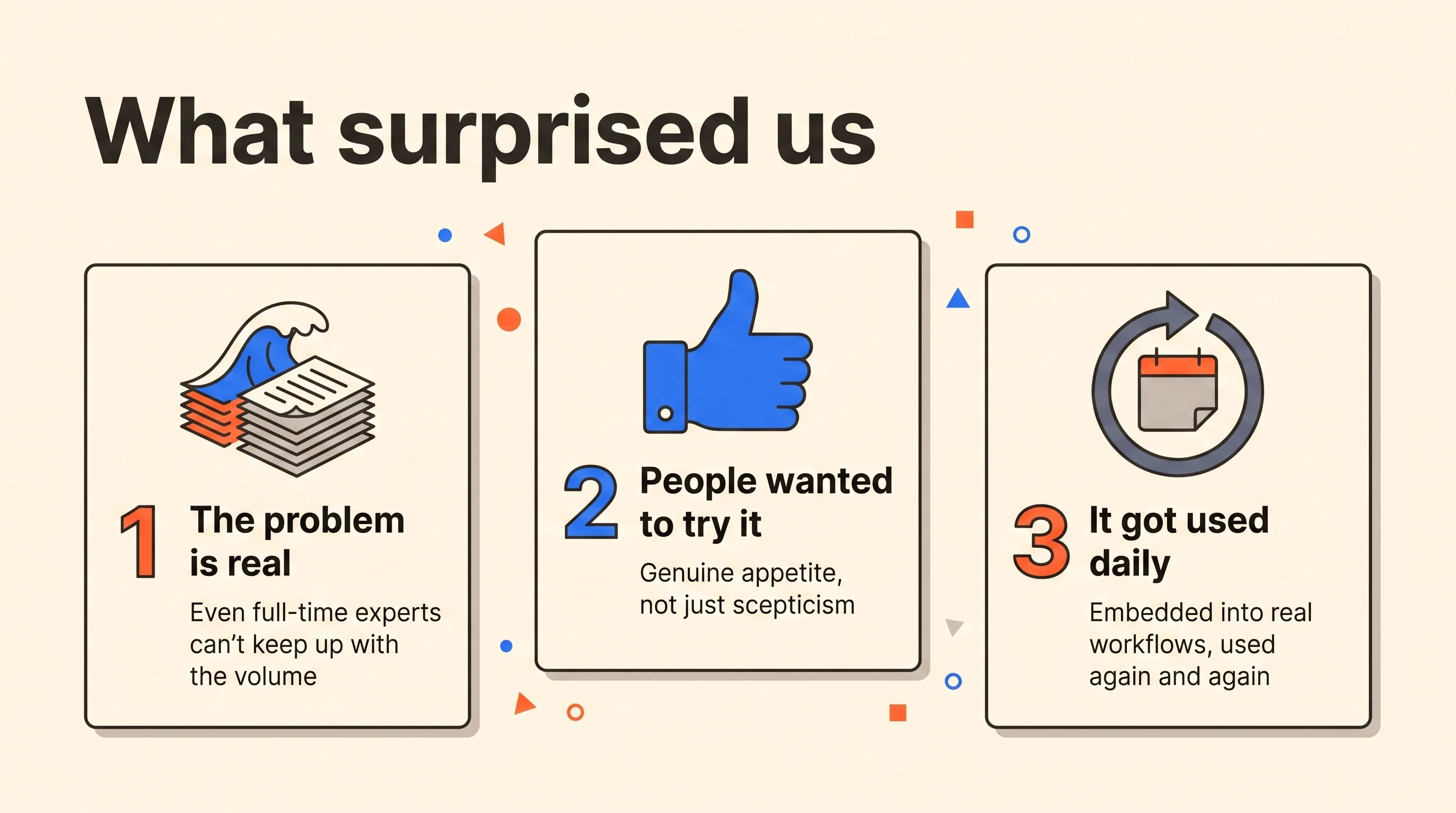
The first surprise was the validation of the problem itself. These were people with deep regulatory expertise, years or decades of experience, and they confirmed what we’d suspected: there is simply too much regulatory output to stay on top of. Even for people whose full-time job is regulatory intelligence. The volume is overwhelming, and it’s increasing.
The second surprise was people’s willingness to try it. We expected scepticism - and there was some, which was healthy - but there was also a genuine appetite to see whether Policy Compass could help with this specific problem. Not replace their expertise, but handle the monitoring and research grunt work so they could focus on interpretation and strategy.
The third surprise - the one that really mattered - was watching it get embedded into daily workflows. You can theorise about product-market fit. You can have a hypothesis. But when you see an energy consultancy using your tool multiple times a day, on new consultations as they land, on code modifications they need to assess for clients, on regulatory research that used to take hours - that’s different. That’s not someone trying your product. That’s someone really using it.
It went from being something interesting to something genuinely useful. And for us as builders, seeing that shift was both surprising and deeply motivating.
Why UK energy regulatory intelligence needs AI
Regulatory intelligence is monitoring change across UK energy’s regulators and industry codes, interpreting each development against a specific business, and keeping every answer traceable to authoritative sources.
The traditional model for staying on top of energy regulation is analyst-driven. Firms employ experts who read publications, write summaries, and distribute reports. That model works - the expertise is real and valuable. But it has structural limitations.
First, it doesn’t scale with volume. When Ofgem, DESNZ, REC (opens in new tab), Elexon, NESO, and industry code panels are all publishing simultaneously, the reading load exceeds what any individual or small team can process. Things get missed. Not because people aren’t good at their jobs, but because there aren’t enough hours.
Second, it can’t contextualise at the individual business level. A generic report on an Ofgem consultation tells you what changed. It doesn’t tell you what it means for your specific licence type, your customer segments, your code obligations. That contextualisation has traditionally required a human conversation - expensive and slow.
Third, it’s reactive. You read what was published. You don’t get alerted to what matters before you’ve had time to notice it yourself.
| The limit | Analyst-driven model | AI-native (Policy Compass) |
|---|---|---|
| Scale | Reading load exceeds any small team once every body is publishing at once | Monitors across the regulators and industry codes continuously |
| Context | A generic report tells you what changed, not what it means for your licence type or segments | Every answer contextualised to your business profile |
| Timing | Reactive - you read what was already published | Continuous - flags what matters before you’d noticed it yourself |
AI changes each of these constraints. Not by replacing regulatory expertise - that remains essential - but by handling the monitoring, filtering, initial analysis, and contextualisation that consume most of the time. The expertise is the valuable part. The grunt work to get there isn’t. Policy Compass does the digging so your team’s time goes back to interpretation, advice, and the decisions that actually need their judgement.
What we’re building
Policy Compass does three things.
Monitoring. We call this Radar. It watches the bodies that matter - Ofgem, DESNZ and the industry codes - and flags what’s relevant to your specific business. Not everything that’s published. What matters to you.
Research. Ask a question, get an answer grounded in authoritative sources only - not the general web, not Reddit, not generic AI training data. Every answer cites its source. You can verify everything.
Deadlines. Consultation response windows, code modification voting deadlines, regulatory milestones - extracted automatically and surfaced so you can plan.
Each of these is contextualised to a persistent business profile that captures who you are - your licence type, customer segments, market participation, geographic footprint. The same Ofgem consultation produces a different answer depending on whether you’re a domestic supplier, an I&C supplier, or an energy consultancy advising both.
It is a force multiplier for your regulatory function. Policy Compass is an AI tool, and like all AI tools, it can make mistakes. We cite every source so you can verify, and we’re explicit that professional judgement should always be the final check. But the research, monitoring, and contextualisation that used to take days? That’s what Policy Compass handles - so your team focuses on the work that actually needs them.
Where we think this is going
The regulatory landscape around UK energy is not going to get simpler. Net zero commitments are driving network upgrades, market redesigns, new flexibility mechanisms, and evolving consumer protections. The volume of regulatory output is going to increase, not decrease.
At the same time, the market is converging. Half-hourly settlement changes how businesses are charged. Flexibility markets create new commercial models. TPI regulation reshapes how energy is sold to businesses. These aren’t isolated changes - they’re interconnected, and understanding the knock-on effects requires being able to see across the whole picture.
We built Policy Compass because we needed to see across that landscape ourselves. We think a lot of people in this sector need the same thing - and most of them don’t have the time or the technical skills to build their own solution.
Eventually, we see regulatory intelligence becoming something that isn’t just for regulatory professionals. If you can distil complex regulatory change into clear, contextualised guidance, that’s valuable far beyond the regulatory team. It’s valuable for commercial decisions, for investment planning, for customer strategy. For us, there’s a natural connection back to our business energy switching platform and the businesses we serve there - because the regulatory decisions being made today directly shape the energy options available to businesses tomorrow.
But that’s the long game. Right now, we’re focused on making Policy Compass the best regulatory intelligence tool available for UK energy professionals.
The bottom line
The volume of UK energy regulatory change is rising, not falling. The monitoring, filtering and first-pass research it demands is what crowds out the interpretation that actually needs an expert - so Policy Compass does that part, contextualised to your business, and hands the judgement back to your team. We built it because we needed it, and we think a lot of this sector does too.
Try it
If you work in UK energy regulation - whether you’re at a supplier, consultancy, flexibility provider, network operator, or anywhere else in the sector - we’d love for you to try it.
We offer a free, team-wide trial with full access. No feature restrictions, no credit card. Use it on a real consultation, a real code modification, a real research question. See whether the time you get back goes to better work.
And if it doesn’t? Tell us why. We’re still learning, still building, and the feedback from people who do this work every day is what makes the product better.
Or get in touch if you’d prefer to talk first.