


Policy Compass vs ChatGPT for UK energy regulatory research is the difference between an ad hoc general-purpose assistant you prompt and a continuous intelligence layer that already knows your business and your role.
ChatGPT is the shorthand here because that is how people search. The same point applies to Claude, Gemini, Grok, Perplexity, or any other state-of-the-art general-purpose agent.
They are useful. A regulatory team can use them to draft, summarise, test wording and explore a question quickly. The problem starts when a general-purpose AI assistant becomes the thing a team relies on to notice, prioritise and interpret regulatory change across UK energy.
That is not the same job.
TL;DR
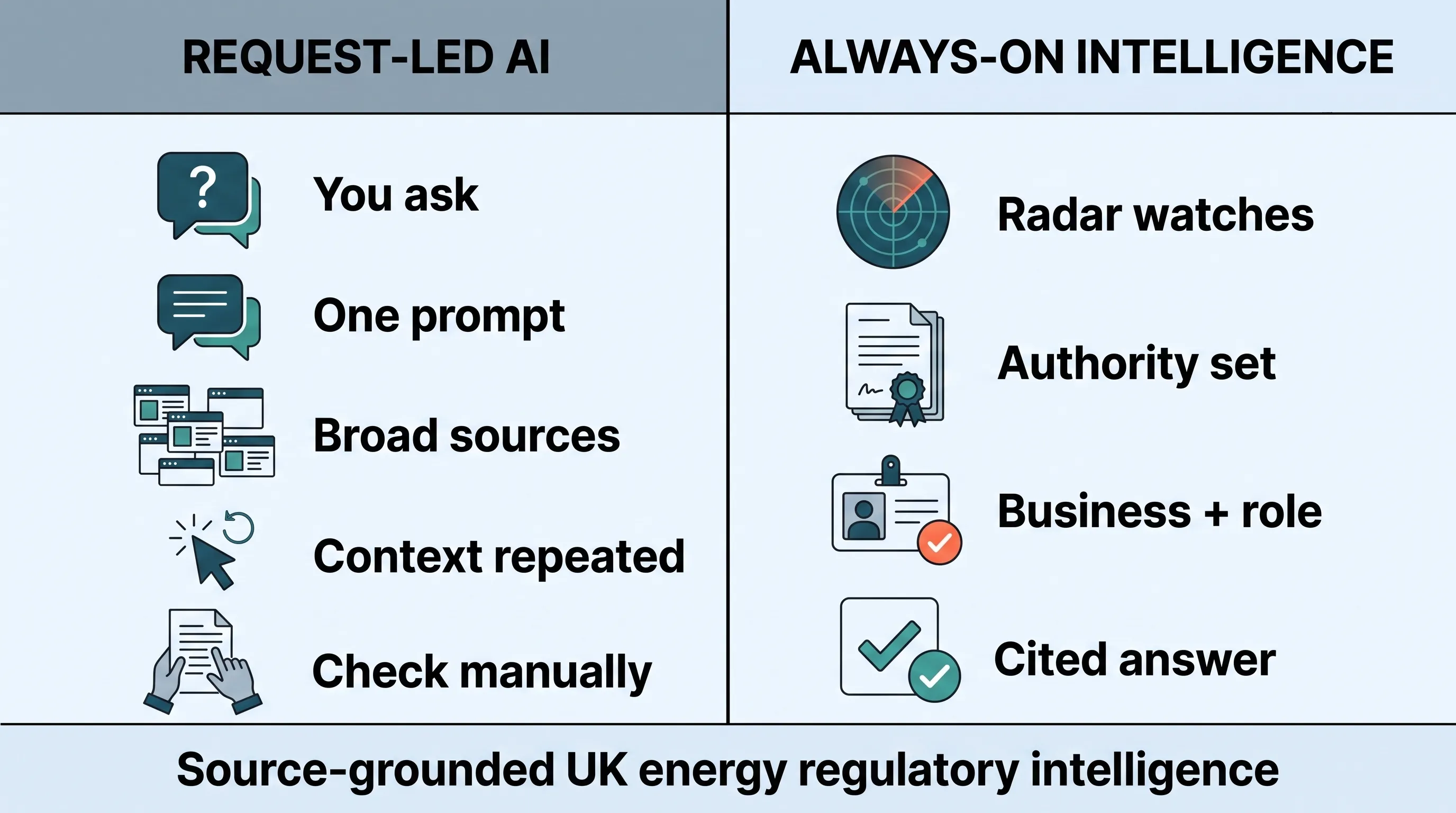
- The short version: ChatGPT, Claude, Gemini, Grok and similar assistants help with questions you already know to ask; Policy Compass is built to surface the developments your team may not have seen yet.
- The source difference: general-purpose agents can search broadly; Policy Compass uses a UK energy regulatory harness that starts from authoritative sources and keeps the evidence trail attached.
- The context difference: Policy Compass knows your business and your role, so the same publication can produce different relevance and commentary for different teams.
- The monitoring difference: general-purpose assistants are request-led; Radar runs continuously, watching across UK energy’s regulators and industry codes in the background - the REC alone logged over 55 change requests in 2023/24.
- The buying decision: Policy Compass vs ChatGPT comes down to fit - use a general assistant where general help is enough, and Policy Compass where regulatory intelligence needs to be source-grounded, contextual and continuously monitored.
Can general-purpose AI handle UK energy regulatory research?
General-purpose assistants can help with UK energy regulatory research when the task is bounded: summarise this document, compare these paragraphs, draft a response outline, or turn a set of notes into something readable.
That is genuinely useful.
The limit is structural. A general-purpose AI assistant answers the prompt in front of it. However capable the underlying model is, it does not wake up already knowing your licence position, your client portfolio, your role split, your priority thresholds, or which developments from the last week have become yours.
For a regulatory function, that gap matters more than the wording of the answer.
Regulatory people are not short of judgement. Their interpretation, experience and market sense are the valuable part. The expensive part is the volume: watching the authoritative sources, separating signal from noise, then doing the deeper source work once something relevant appears.
Policy Compass is there to be a force multiplier for that judgement, not a replacement for it.
The work is not just “find me information”. It is:
- what changed;
- which source it came from;
- whether it applies to this business;
- who inside the team needs to see it;
- what the evidence is;
- what still needs expert judgement.
General-purpose AI can help with parts of that workflow. Policy Compass is built around the workflow itself.
Policy Compass vs ChatGPT: where the line is
Policy Compass is not trying to be a better chatbot. It is a regulatory intelligence platform for UK energy professionals.
Regulatory intelligence, in the Policy Compass sense, means monitoring change across UK energy’s regulators and industry codes, interpreting each development against a specific business and role, and keeping every answer traceable to authoritative sources.
That definition is the line between generic AI and a specialist system.
A general-purpose assistant can generate a plausible response if you ask the right question. Policy Compass is designed for the point before that: knowing which question should be asked, which publication triggered it, and why it matters to this business rather than another one.
The question is not “can AI read a regulatory document?”
It can.
The question is whether your regulatory intelligence should depend on someone remembering to prompt it.
| Capability | Generic AI assistant | Manual monitoring | Policy Compass | Verdict |
|---|---|---|---|---|
| Ongoing monitoring | Only when prompted or configured around a task | Depends on the team calendar | Radar runs in the background | Policy Compass owns the continuous monitoring job |
| UK energy source discipline | Broad web unless tightly constrained | Strong, if the team has time | Authoritative UK energy sources by design | Policy Compass is narrower on purpose |
| Business context | Must be re-explained or stored elsewhere | Held by the practitioner | Persistent business profile | Policy Compass keeps context attached |
| Role context | Usually absent unless prompted | Informal and person-dependent | Interpretation changes by role | Policy Compass reflects how teams split work |
| Evidence trail | Possible, but needs checking | Manual | Source-grounded answers with citations | Policy Compass is built for verification |
| Discovery of missed signals | Weak unless you ask | Weak when volume rises | Signals are surfaced by relevance | Policy Compass reduces reliance on memory |
Why the Regulatory Harness matters more than the model
The model is not the whole product. For UK energy regulatory research, the Regulatory Harness around the model matters as much as the model itself - the specialist scaffolding that decides what a capable model is actually pointed at.
That harness is the part that decides where to look, what to exclude, how to move between related source materials, what context to attach, and which claim needs which citation. A state-of-the-art general model without that harness is still being asked to improvise a regulatory workflow from a prompt.
Policy Compass is built the other way round. The harness starts from authoritative UK energy regulatory sources, attaches business and role context, and keeps the answer traceable back to the material it relies on. It is deliberately not a broad web assistant pulling from whatever appears plausible in search results, forums, Reddit threads or video transcripts.
That source discipline matters because UK energy regulation lives and dies in nuance. A sentence in an Ofgem consultation, a BSC modification route, a REC change-process update and a Grid Code modification can look similar at summary level while carrying very different consequences for a specific business or role.
These are illustrative, not the full picture - enough to show the shape of the problem.
Ofgem’s consultations page (opens in new tab) describes consultations, calls for input and responses that help develop policies or changes. DESNZ’s consultation hub (opens in new tab) carries live consultations and calls for evidence. Elexon’s BSC guidance (opens in new tab) distinguishes Modifications, Change Proposals, Draft Change Proposals, Standard Changes and Issues, and says a Modification will typically take six to eight months to progress to a final decision before implementation time is added. REC’s June 2024 change-process update (opens in new tab) said over 55 new requests were raised in 2023/24 and that the volume of change had been higher than estimated. NESO’s Grid Code modifications page (opens in new tab) lists current and concluded modifications by ID, status and update date.
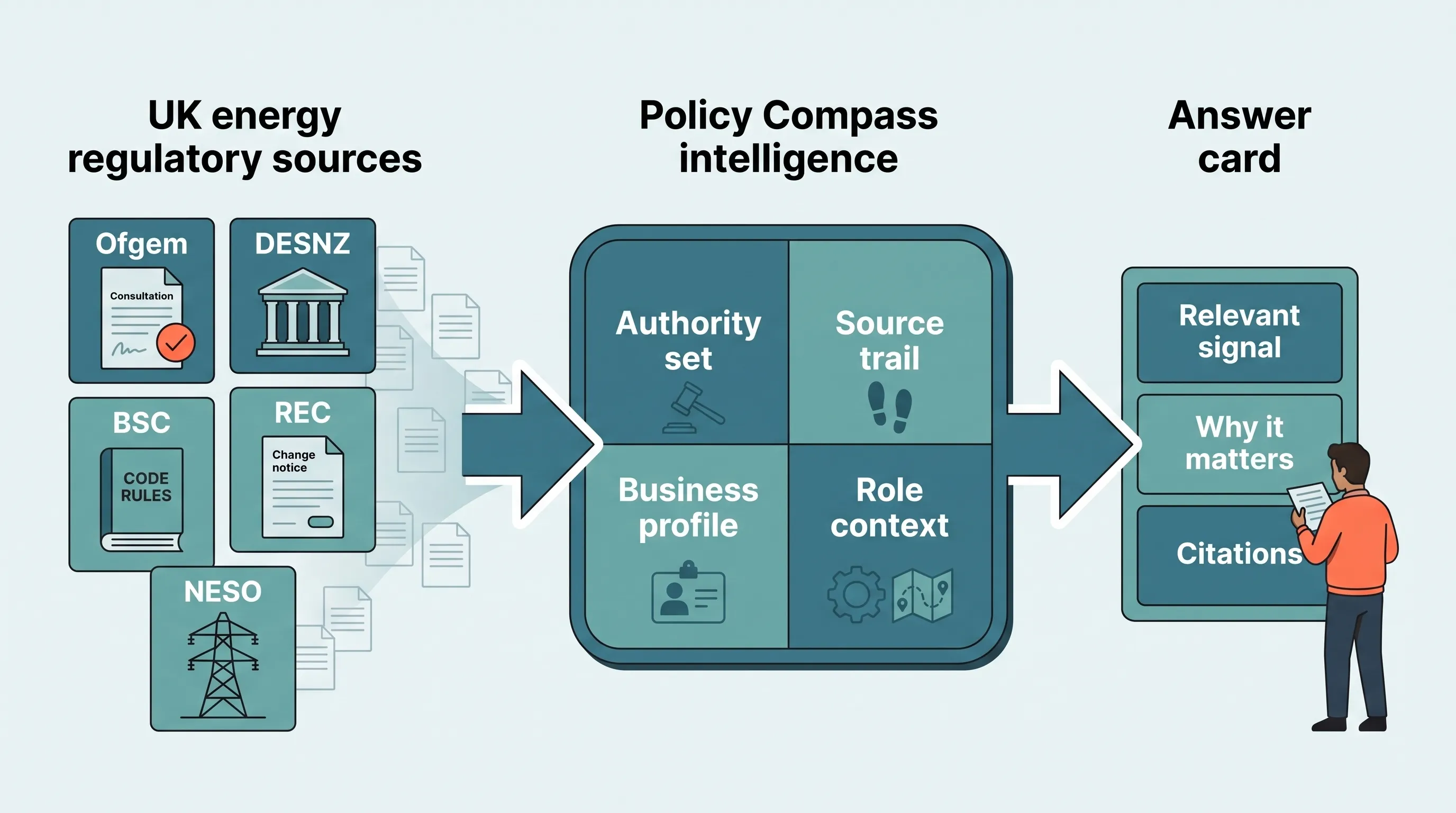
The harder question is not whether a model can summarise a PDF - most can - but whether the system around it is disciplined enough for regulatory work: the right sources, the right context, the right date, the right confidence level, and a clear path back to the original material.
Generic AI can be pointed at that material. Policy Compass is built so that material is the starting point.
What Policy Compass adds that a prompt cannot
Policy Compass adds five layers that a prompt alone does not give you. Together they are the Regulatory Harness - the five layers that turn a capable model into UK energy regulatory intelligence.
Authority Set. Policy Compass starts from the source base a UK energy regulatory team would actually trust. The source, research and citation layer is built for that world, not for the open web as a whole. It is designed to reduce the room for hallucination because claims are pulled back toward source material rather than model memory.
Business Context. A supplier, a consultancy, a flexibility provider and a network operator can read the same publication and walk away with different next questions. Policy Compass keeps the business profile attached, so the interpretation starts from the organisation in front of it.
Role Context. Inside the same organisation, the same development can matter differently to the person on codes, the person on retail, the person on commercial strategy and the person accountable for responding. That is one of the clearest things design partners pushed into the product. Policy Compass treats it as a first-class part of the answer.
We have written separately about what changes when Policy Compass knows your company and your role. The short version is that role-aware intelligence is not a nicer prompt. It is the part of the harness that decides whether the same source signal is urgent for one person and background noise for another.
Monitoring (Radar). Radar reads across UK energy’s regulators and industry codes in the background, not waiting for a neat prompt. It surfaces the changes that appear relevant, explains why, and leaves the expert to decide what to do next.
Deep Research. Once something matters, Policy Compass can keep working through the source trail: moving from a regulator page into the underlying consultation, from a code-change notice into related guidance, or from one publication into the source that gives the answer. The job is not just to find the first relevant page. It is to help the expert get to the nuance faster.
This is where the product is deliberately narrower than a general AI assistant.
The scope is narrow on purpose: the UK energy regulatory question, answered with the right source base, in the right business context, for the right person.
When should a regulatory team use general-purpose AI instead?
Use a general-purpose assistant when the task is generic, low-dependency and straightforward to verify.
Drafting a first version of a consultation response structure. Rewriting an internal note for a different audience. Brainstorming questions to take into a meeting. Turning dense notes into clearer prose.
That work benefits from a general assistant.
The handoff point is where the answer becomes source-sensitive, business-specific or time-sensitive. If the question is “what changed this week that matters to this profile?”, “which live consultation creates work for this role?”, or “what does this code change imply for this client portfolio?”, the assistant is no longer doing generic text work. It is doing regulatory intelligence - the problem we built Policy Compass to handle.
The practical split is simple: let the general assistant help with general work, and let Policy Compass absorb the monitoring, relevance filtering and deep source research that slows excellent regulatory people down.
Sources
- Ofgem consultations (opens in new tab) - consulted 6 July 2026.
- DESNZ consultation hub (opens in new tab) - consulted 6 July 2026.
- Elexon BSC Change Process Guidance Note (opens in new tab) - consulted 6 July 2026.
- REC change-process update (opens in new tab) - published 24 June 2024, consulted 6 July 2026.
- NESO Grid Code modifications (opens in new tab) - consulted 6 July 2026.
The bottom line
ChatGPT, Claude, Gemini and Grok answer the question you thought to ask. Policy Compass watches regulatory change across UK energy’s regulators and industry codes and tells you what a given development means for your business and your role - often before it is on your radar.
That is the line between search and intelligence.
If your team already uses a general-purpose assistant, keep using it where it fits. Just do not confuse a general assistant with the system that should be watching the market on your behalf. That distinction is worth testing on your own regulatory patch - request a trial and test it there, free and with full access.