


TL;DR
- Built with partners: we didn’t design our regulatory intelligence platform in a vacuum - we built Policy Compass with design partners across UK energy: consultancies, suppliers, flexibility teams and network operators.
- The job is triage: everyone is drowning in regulatory volume, so the job is triage, not reading. Radar monitors the firehose and scores each item out of ten for how relevant it is to you, with a line on why.
- Trust broke on hallucination: generic AI lost their trust the first time it made something up. So every claim in Policy Compass cites a source you can click through and check - and it is honest about what it can’t confirm.
- Role, not just company: the same regulation means different things to different people. Policy Compass knows your business and your role, and re-scores every signal for the work you actually do.
- The real competitor is manual: it isn’t another AI - it’s manual monitoring and “phone a friend”. We amplify a small team rather than replace the expert; the judgement still belongs to them.
The best decisions we’ve made about Policy Compass didn’t come from a whiteboard. They came from sitting with people who do this work for a living - regulatory leads at suppliers, consultants juggling client portfolios, small teams at flexibility providers and network operators - and listening to where the job actually hurts.
We’re keeping who they are private. But the lessons are too useful not to share, and they explain a lot about why the regulatory intelligence we built looks the way it does. Here are five that came up again and again.
1. Everyone is drowning in volume - the job is triage, not reading
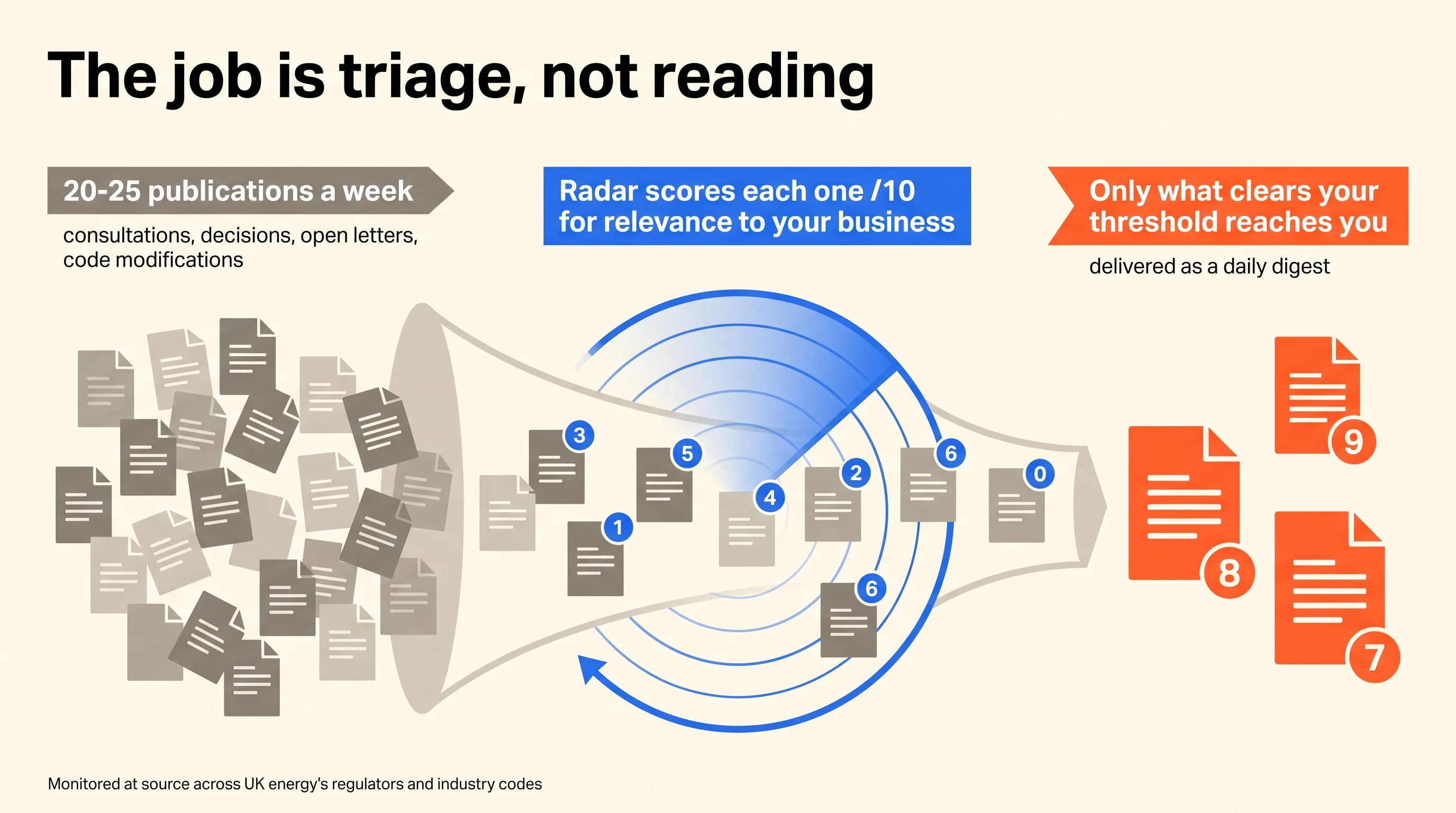
Every team described the same thing: a relentless stream of consultations (opens in new tab), decisions, open letters and code modifications from a dozen different bodies. One way it was put to us stuck: across our design-partner conversations in 2026, teams described twenty to twenty-five publications landing in a single week, and the hard part isn’t reading any one of them - it’s working out which three actually matter to you.
That reframed the problem for us. The bottleneck was never reading speed; it was triage. So we built Radar to do the monitoring - reading across UK energy’s regulators and industry codes, at source, every day - and, more importantly, to score each item out of ten for how relevant it is to you, with a line on why. The day’s signals that clear your threshold arrive as a digest. The point was never “here’s everything.” It’s “here’s what to look at, and here’s what to ignore.”
2. Generic AI lost their trust the first time it made something up
Trust was the most consistent theme of all, and the strongest. These are precision professionals - a wrong figure or a misread clause isn’t a wasted hour, it’s a reputational risk and bad advice to a client. Several had already been burned by general-purpose AI inventing a number or citing a source that didn’t exist.
So the bar they set us was clear: every claim has to cite a source you can click through to and check, and the tool should be honest about what it can’t confirm rather than bluffing. That’s why Policy Compass only draws on authoritative sources like Ofgem (opens in new tab), DESNZ (opens in new tab) and the industry codes such as the Retail Energy Code (opens in new tab) - never forums, blogs or video. Every answer is cited. It’s the difference between a general-purpose chatbot and a source-grounded tool, and the test we hold it to is simple: would you be comfortable putting this in a board paper?
3. The same regulation means different things to different people
We started out thinking “context” meant knowing the company. Our partners showed us it goes a layer deeper.
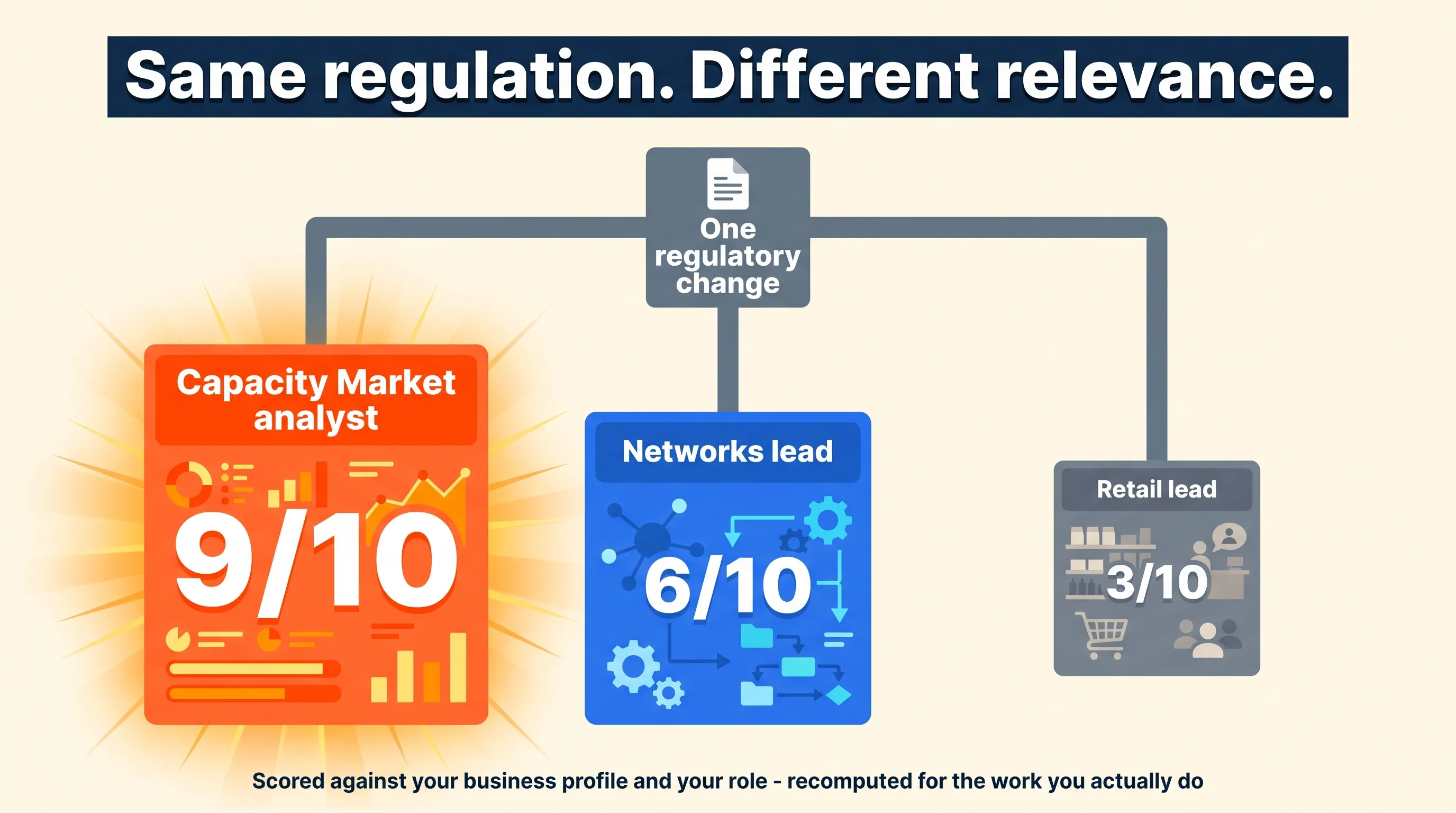
Consultancies kept telling us every client is a different regulatory puzzle - a change that’s critical for a network client is noise for a retail one. Suppliers said the same about their own book: a single modification might hit one customer segment and leave the rest untouched. And inside larger regulatory teams, people split the market between them - one person on the codes, another on networks, another on retail. The same publication can be a nine-out-of-ten for one of them and a three for the colleague at the next desk.
So Policy Compass keeps a persistent business profile - it already knows your licence, segments and market exposure, and applies that to everything - and then lets each person set their role on top, so relevance and commentary are recomputed for the work they actually do. Consultancies get a profile per client; suppliers get intelligence scoped to their segments. Nobody has to wade through the same firehose. Those three ideas - authoritative sources first, then business context, then role - are the scaffolding we now call the Regulatory Harness: the layers we wrap around the model so the answer is grounded, contextual and pointed at the right person.
4. It’s grey, not black-and-white
A point several partners made, in different words: modern UK energy regulation is increasingly principles-based. The work has shifted from “the rule says no” to “can we justify this position against the principle?” - from “don’t do bad things” to “prove you’re doing good things.”
That mattered for two reasons. First, it’s why a tool like this has a market at all: if everything were black-and-white, there would be nothing to interpret. Second, it means the same regulation can reasonably be read from different risk stances. So we’re building interpretation into the product rather than pretending there’s one right answer - the judgement still belongs to the expert; we just do the legwork that gets them there faster.
5. The real competitor isn’t another AI - it’s “phone a friend”
We assumed we were competing with generic AI tools. We weren’t. Almost without exception, the thing Policy Compass actually replaces is the manual status quo: a weekly trawl of regulator websites, an Excel tracker, a monthly triage meeting, trade-body memberships - and, when something’s genuinely unclear, calling someone who knows more and waiting for a reply.
| The manual status quo | With Policy Compass |
|---|---|
| A weekly trawl of regulator websites | Radar reads across the sources at source, every day |
| An Excel tracker of what changed | Deadlines extracted and tracked automatically |
| A monthly triage meeting | Every signal scored for relevance as it lands |
| ”Phone a friend” and wait for a reply | A cited answer from authoritative sources, now |
That changed how we think about the value. We’re not trying to replace the expert - the expert is the point. We’re trying to give a small team the reach of a much bigger one: the 80% that’s grunt work, handled, so the expert 20% gets all the attention. Tellingly, our partners benchmarked the price against an analyst’s salary or an incumbent alert subscription, not a consumer AI plan - because that’s the real comparison.
What we’re still learning
We’re not done. Partners are pushing us on operational outputs - turning a dense code modification into an implementation brief an engineering team can actually scope - on the breadth of sources we cover, and on fitting into the tools they already work in rather than adding another to the pile. We’d rather integrate than duplicate.
The throughline is simple, and it’s the thing we’d tell any founder: build it with the people who’ll use it. It’s the same instinct that led us to start Policy Compass in the first place, and the product is sharper for every conversation we’ve had - we’re excited to have more.
If you want to see what came out of those conversations, request a free trial.