


We define AI regulatory intelligence as the use of AI to monitor regulatory change continuously, interpret each development against a specific business, and ground every answer in the primary sources. Policy Compass is that, built for UK energy: it watches what is published across the sector’s regulators and industry codes, creates commentary on every signal as it lands, and surfaces the ones that matter to your business and your role.
That last component took the longest to get right. It is also what this post is about.
TL;DR
- What it is: continuous monitoring, contextualised interpretation and source-grounded research in one platform - AI regulatory intelligence rather than search, and intelligence rather than compliance.
- Why now: tools promising this were tried before modern AI and went nowhere. Large language models changed what is possible: everything published can now be read, interpreted and triaged per business.
- Why UK-native matters: the category is being defined by horizontal compliance platforms built for other jurisdictions. UK energy’s regulatory detail lives in its industry codes, and a tool that treats the sector as one more jurisdiction misses where the work actually is.
- What it isn’t: a compliance tool. Policy Compass interprets; it never tells you whether you are compliant.
The other AI conversation in UK energy regulation
Two conversations about AI are running in UK energy regulation right now, and they blur into each other. The louder one is about regulating AI: Ofgem published good-practice guidance on AI use in the sector in May 2025 (opens in new tab), has been developing its approach to AI oversight (opens in new tab) since, and opened a call for input on AI assurance in June 2026 (opens in new tab) - Energy UK responded in August 2026 (opens in new tab).
This post is about the quieter one: what AI changes about the work itself. I have spoken to around twenty regulatory teams this year - consultancies, suppliers, flexibility providers, network operators - and nearly every one of them said some version of the same thing: the team is too small, everyone is spread too thin, and keeping up eats the time the actual work needs. That is the problem that Policy Compass exists to solve.
Why AI regulatory intelligence only became possible now
Automated regulatory tracking has been tried before. It went nowhere. A regulatory director with decades in the sector told us platforms promising exactly this appeared years ago, well before modern AI - his verdict: “no value add” beyond pulling the PDF documents and reading them yourself.
Two things killed those early tools. The first is obvious: without AI, a tracking tool is a filing cabinet with alerts. The second is the one I keep coming back to. The tools that tried to guess what mattered guessed wrong, he said, because what matters to one team is different from what matters to the next. Relevance depends on your commercial position, your licences, your markets. It was never a property of the document.
LLMs fixed the first problem: reading everything published and saying something genuinely useful about each item is now possible. But that alone just gives you a better-written pile. The job was never to read faster - it was to know which of this week’s publications change your work, and which are safely someone else’s problem. That is the problem we built Policy Compass around.
How Policy Compass does AI regulatory intelligence
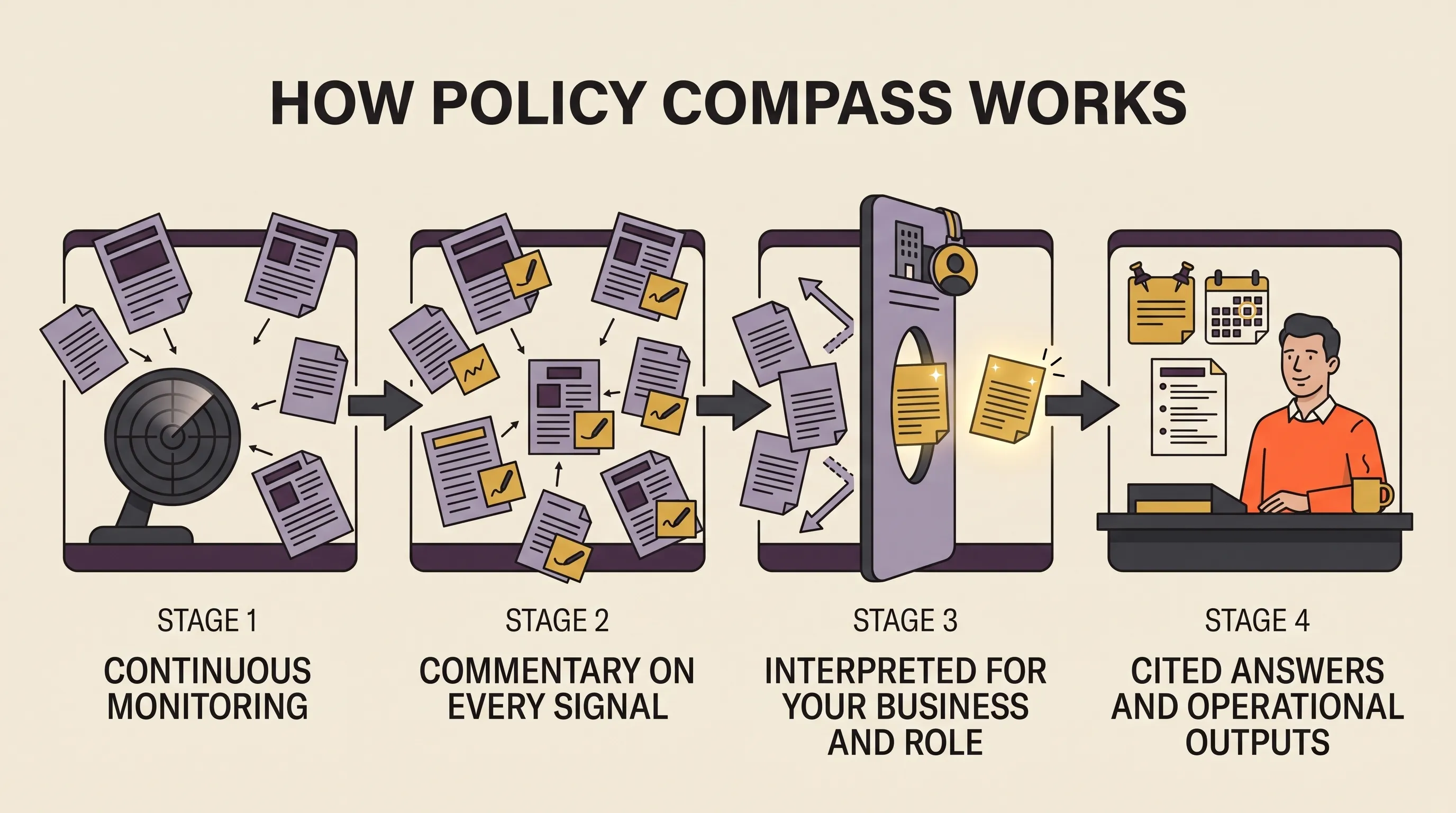
Policy Compass runs the workflow in four connected parts.
Continuous monitoring, across everything published
UK energy’s regulatory output is fragmented by design: each regulator and code body publishes on its own site, in its own structure, on its own schedule - and some circulate consultations by mailing list, so if you are not on the list, you find out late. We wrote about that aggregation problem separately. Radar, Policy Compass’s continuous monitoring layer, watches across UK energy’s regulators and industry codes and creates commentary on every signal published, as it lands. Not a subset filtered per customer - the same broad watch behind every account.
Interpretation against your business and your role
Every account has a persistent business profile, and each team member adds their role. That is what the commentary is assessed against. The same group regulatory team might have one person covering electricity, another gas, another heat - each wants only their patch, while the director wants all of it. Role-aware interpretation is what makes a monitoring feed usable at both altitudes: relevance decided per business, then per person.
One regulatory lead trialling Policy Compass told me the first thing it surfaced was a NESO request for information they had not been aware of. That email honestly made my week. This is the entire job: the important things, brought to you before you even knew to ask.
Research that is ring-fenced to the primary sources
The most common question we get asked is “how is this better than ChatGPT or Claude?” - it is common enough that we wrote the comparison up in full. The short answer is the ring fence. Policy Compass’s research agent works only within authoritative sources - the regulators, government departments and code bodies. The open web does not exist to it. It reads the actual documents. Every claim comes back with citations you can check and export.
We built it that way because of something I said to my co-founder very early on: energy regs and policy people are very smart. They will know if it’s lying. Not suspect - know. Regulatory professionals test AI tools the way they test junior analysts, on questions they already know the answer to, and one fabricated citation is the end of the conversation. One consultancy that trialled it told us the answers gave them ideas they had not thought of themselves. That is the bar the ring fence exists to protect.
Operational outputs, not just awareness
Awareness on its own changes nothing. The workflow ends in the artefacts regulatory teams actually produce: deadlines tracked from the documents they come from, a weekly team priorities view, briefings and summaries, and consultation responses drafted from your team’s own previous submissions - the volume work of responding, with your positions and voice preserved for your experts to shape.
AI regulatory intelligence vs generic AI and compliance platforms
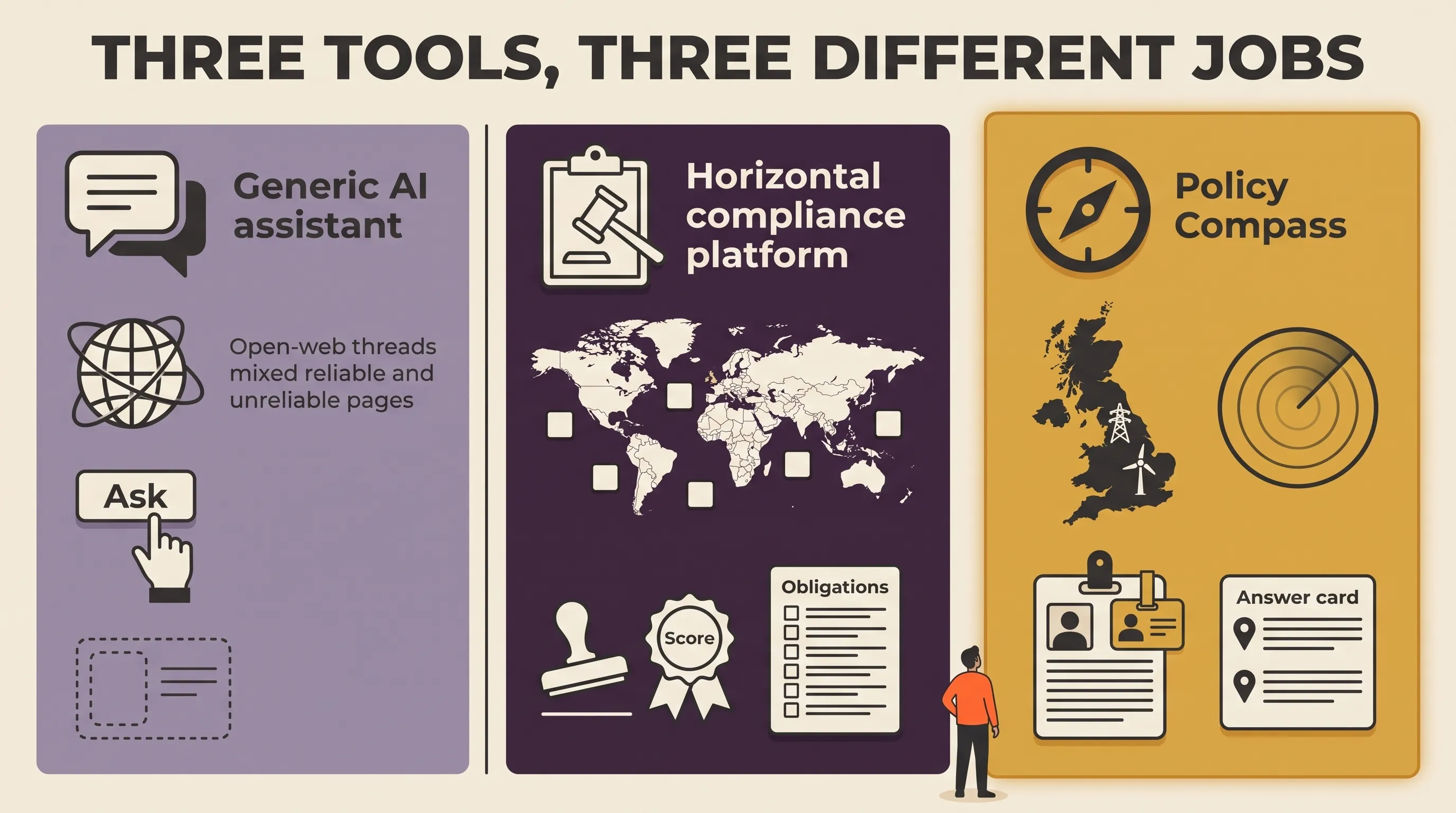
| Capability | Generic AI assistant | Horizontal compliance platform | Policy Compass |
|---|---|---|---|
| Knows UK energy’s codes and bodies natively | No - open-web general knowledge | Partially - one jurisdiction among many | Yes - built for UK energy only |
| Knows your business | No persistent business profile | Configured for obligations, not context | Persistent business profile |
| Knows your role | No | No | Role-aware interpretation |
| Monitoring | Reactive - answers when asked | Rule and requirement tracking | Continuous, with commentary on every signal |
| Source grounding | Open web | Varies | Authoritative sources only, every claim cited |
| Output framing | Prose answers | Compliance verdicts and scores | Interpretation - what this means for you |
The middle column is where the category’s name is being pulled. Search for “AI regulatory intelligence” today and most of what ranks appears to be horizontal compliance software - platforms built to track obligations across many industries and jurisdictions, framed in verdicts and scores. That is a legitimate product category. In our view it is the wrong shape for UK energy, for two reasons.
First, the operational detail of this sector does not live in one place a horizontal platform would think to look. It lives across the industry codes and the bodies that govern them, published in fragmented formats that take deliberate engineering to cover properly.
Second, verdicts are the wrong output. A compliance score tells a regulatory professional nothing they can act on. What changed, what it means for us, what do we need to do and by when - that is the actual question, and answering it requires interpretation against your context, not assessment against a checklist.
What Policy Compass is not
Policy Compass does not assess whether your business is compliant. We drew that line deliberately: compliance judgement belongs to your team and your regulator, and a tool that pretends otherwise is guessing with your licence at stake.
It is also not a replacement for expertise. The teams we build with have spent careers in this domain and know it far better than we do. Policy Compass exists to remove the grunt work, triaging and first-draft work that eats their week, so they can put their expertise and judgement into the things that really need them. One user, caught between the end of a trial and a procurement decision, put it more plainly than we ever have: “I really feel the difference without it.”
The bottom line
This is how we think AI regulatory intelligence should work: monitoring, interpretation and research as one platform that knows whose desk it is reading for - your business, your role. We can only speak for the version we built: Policy Compass, UK energy only, grounded in the sector’s own primary sources. The regulating-AI conversation will keep filling the headlines. The working-with-AI one is quieter, and it is already changing how the teams we work with spend their week - request a trial and judge it on your own patch.
Sources: Ofgem: AI in the energy sector - new guidance launches (May 2025) (opens in new tab) · Ofgem: artificial intelligence (opens in new tab) · Ofgem: AI assurance call for input (June 2026) (opens in new tab) · Energy UK: response to Ofgem AI assurance consultation (August 2026) (opens in new tab) · NESO: industry codes (opens in new tab)