


To track UK energy code changes today you still go code by code. Each code runs its own change process, on its own site, in its own format, with its own status vocabulary and its own meeting calendar. Watching all of them means watching each of them.
That is the aggregation problem. Nobody designed it - the codes were never built to be read together.
Policy Compass answers that with Radar: continuous monitoring across UK energy’s regulators and industry codes, triaging what it finds against your business and your role, so what reaches you is the change that matters rather than the change that happened.
TL;DR
- Gap: to track UK energy code changes today you check each code’s own register. The consolidated views that exist are periodic spreadsheets, and turning them into a live picture falls to you.
- Cause: each UK energy code was built with separate governance, a separate administrator and a separate change process.
- Change: in its second decision on implementing energy code reform (6 March 2026), Ofgem set out decisions on the modification process and on cross-code working. Phase 1, covering the Balancing and Settlement Code and the REC, is planned to go live from November 2026.
- Workarounds: teams stay across it reactively - checking the sites they know, reading the publications, hearing it from a colleague. It works, until the person leaves, a source moves, or the volume spikes.
- Radar: Policy Compass’s continuous monitoring layer takes on the triage you currently do at the end of the day, and tells you why a change matters, not just that it exists.
Why there is no single live register of UK energy code change
Each UK energy code publishes its own change record, and none of them is authoritative for the others. The cost sits in the assembly.
Ofgem’s energy codes page (opens in new tab) is a list of codes, not a feed of what is changing inside them. Each one runs its own change process, on its own timetable, and no live index sits across them. Even the decision layer is split, between Ofgem and the code bodies.
The day-to-day record of what has been raised, what is in workgroup and what is about to be implemented lives with each code body: NESO (opens in new tab), the Retail Energy Code (opens in new tab), the Smart Energy Code (opens in new tab), and so on. Those are the registers a team opens.
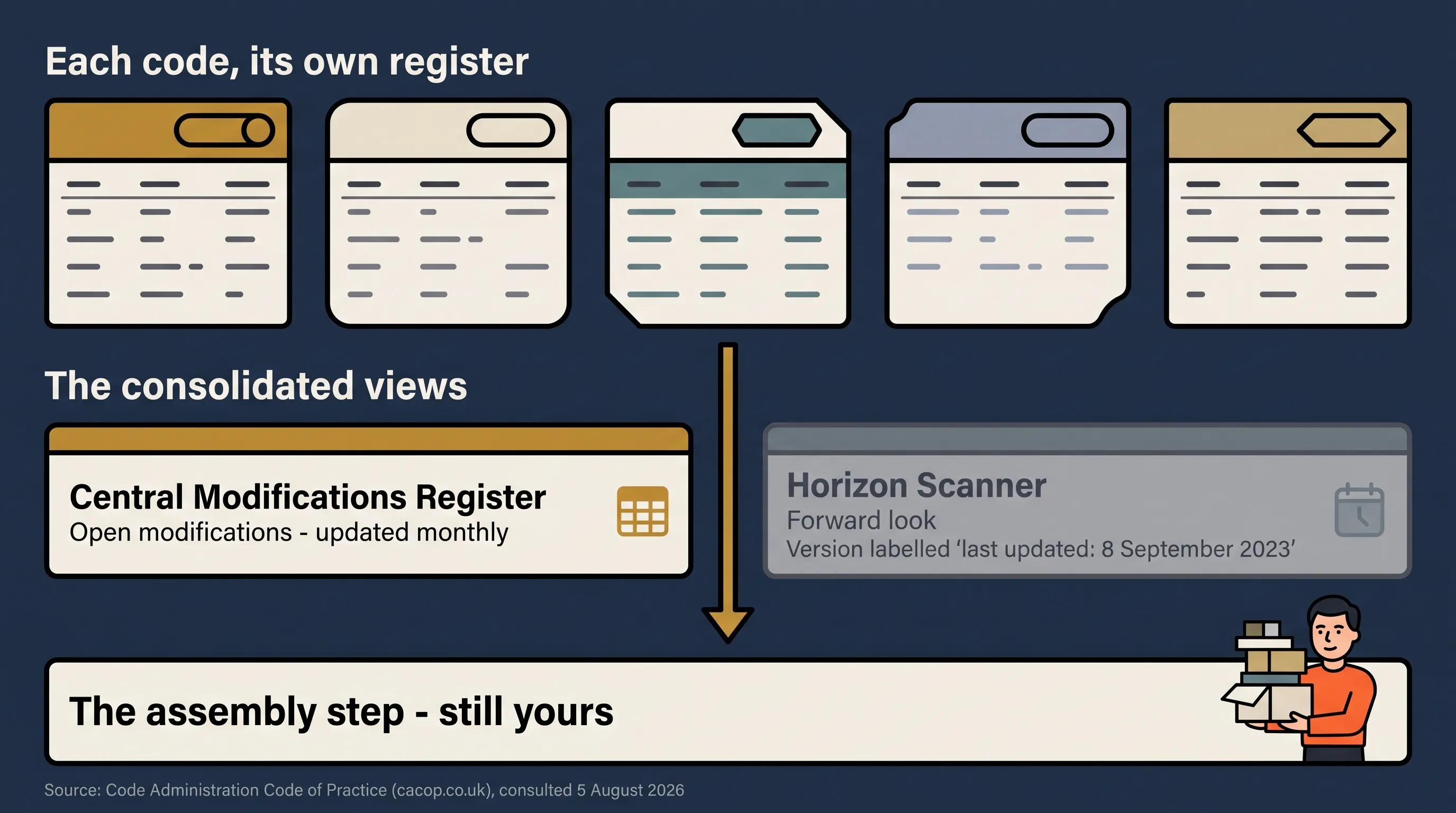
Consolidated views do exist. Ofgem’s page hands off to the industry’s Code Administration Code of Practice directory (opens in new tab), which links out to each administrator’s own site. CACoP also publishes a Central Modifications Register (opens in new tab) - on its own description, “a consolidated list of all the open Modifications across all the CACoP Codes”, reviewed and updated “once a month” and downloaded as a spreadsheet.
That is a snapshot, not a feed. It carries what is open rather than what moved this week, and it tells you to “follow the links within the register to the dedicated webpage for that change” for anything more. Its forward-look companion, the Horizon Scanner, is updated twice a year, and the version published on that page is labelled “last updated: 8 September 2023” (all consulted 5 August 2026).
In the reform framework Ofgem proposes to retain the cross-code steering group (CCSG) change tracker, with code managers keeping it current, which Ofgem says “should help ensure that cross-code activity is transparent to wider industry” (Ofgem, Implementation of energy code reform: second decision, 6 March 2026 (opens in new tab), paras 2.137 and 2.146). It appears to be a coordination artefact covering the items brought to the group, not a live record of what each code has raised or is about to implement.
So the practical unit of work is one register at a time. This one, then that one, then the third, each listing its code modifications in a different layout, under a different idea of what counts as an update. Then hold the results in your head long enough to notice that two of them are about the same underlying change.
That last step is the one that does not scale, and no per-code register was ever built to take it for you.
How Ofgem’s energy code reform changes who publishes what
Ofgem’s energy code reform is moving the map itself: who administers each code, and therefore who publishes its change record. That is the part a fixed routine cannot absorb.
In its second decision on implementing energy code reform (opens in new tab) (6 March 2026), Ofgem set out its decisions on the modification process, a new Stakeholder Advisory Forum and cross-code working. The same document sets the shape of the transition. Reform of industry code governance under the Energy Act 2023 moves code administration to licensed code managers in three phases, with phase 1 covering the BSC and the REC planned to go live from November 2026. Elexon and RECCo are the named phase 1 candidates. As at that decision, Ofgem was developing consolidation proposals ahead of industry workgroups planned for summer 2026, and had opened a call for expressions of interest to join a code consolidation workgroup for a consolidated electricity commercial code and a consolidated gas network code. Neither the BSC nor the REC is consolidated in the first phase.
The cross-code decision is the one that bears on tracking. Ofgem set out in consultation that the cross-code steering group “was set up under the REC to better facilitate cross-code change”, and proposed those arrangements “as the basis for an updated cross-code change process in all codes” (para 2.121). In this decision it confirmed it intends to take that forward (para 2.132). The implementing code text was consulted on alongside the decision; that consultation (opens in new tab) closed on 17 April 2026 and is awaiting decision.
We read that as the regulator building dedicated machinery for cross-code change. If that coordination needs its own institution, it is not one person’s side task on a Thursday afternoon.
How regulatory teams track code changes today
Regulatory teams already track code change, and most of them track it well. What they do not have is anything doing it for them.
What they have is a habit, built up over years. Checking the sites that matter to them. Reading the publications. Watching what people in the industry are talking about, in working groups and on LinkedIn and over coffee at a conference. Holding a private sense of which source lands first for which code - teams we work with will follow a code body’s mailing list rather than that body’s own website, because in their experience the mailing list gets there first.
In our view plenty of tooling is sold against a strawman of teams doing nothing. Teams are not doing nothing.
But it is reactive. It surfaces what you happened to see, from the sources you happened to check, on the day you looked. That works, and it is exposed in three specific ways:
- Ownership: it lives in one person’s head, and it leaves when they do.
- Stability: code reform is about to test whether the sources stay put, one licensed code manager at a time.
- Volume: it degrades exactly when the stakes are worst. The miss you never see is the expensive one.
When your team has already built an internal tracker
Larger teams often go further and build one: a scraper, a scheduled job, a shared sheet, sometimes a model summarising on top. That is a reasonable thing to have done, and some of them are genuinely good.
An internal tracker is also, in our experience, more often than not a side project - built by someone with a day job, in the gaps, against sources that were stable when they wrote it. Today it works. The harder questions are the ones about tomorrow: who owns it when that person moves on, who notices the morning a code body redesigns its site, and who is accountable if it keeps running but quietly stops being complete.
That is the difference between an internal tool and a production product, and it is not a judgement on the engineering. It is a judgement on what gets maintained when maintaining it is nobody’s actual job. Code reform is about to test exactly that: administration moves to licensed code managers, and where a code changes hands, the sources a tracker was pointed at can move with it.
How to track UK energy code changes in one place
To track UK energy code changes in one place you have to stop tracking them code by code and let something else do the assembly. Four things have to hold:
- Work from scope, not a source list. Decide which codes and regulators are in play for your business, rather than rebuilding a list of source sites each time code reform moves one.
- Anchor relevance to your business. A change only means something in the context of what your business actually does. That profile is built with you, not left as a configuration task.
- Add the role dimension. Your team sets their own roles, so the same code change reads differently for a settlement lead and for a head of regulation.
- Let continuous monitoring do the triage. What reaches you is the relevant item, with the reason and the source attached, and a change touching more than one code arrives as one development.
Radar is Policy Compass’s continuous monitoring layer. It watches developments across UK energy’s regulators and industry codes, assesses each one against your business and your role, and surfaces the ones that matter to you with the reason and the source attached. What does not apply does not reach you. See how Radar works in the product.
The difference is not coverage. You could, in principle, subscribe to all of it yourself, or pay someone to read it for you.
The difference is where the triage happens, and what it is triaged against: your business, and the role you read it from. Subscribe to each code body and you relocate the fragmentation from several browser tabs into one inbox - keeping up is an operating-model problem, not a reading-speed one. The filtering still lands on you, at the end of a day. What a change actually means for your business should land on you - that is your expertise and your experience, and no tool should be taking it off you. The filtering is a different job. That one is volume, and it is the one worth handing over.
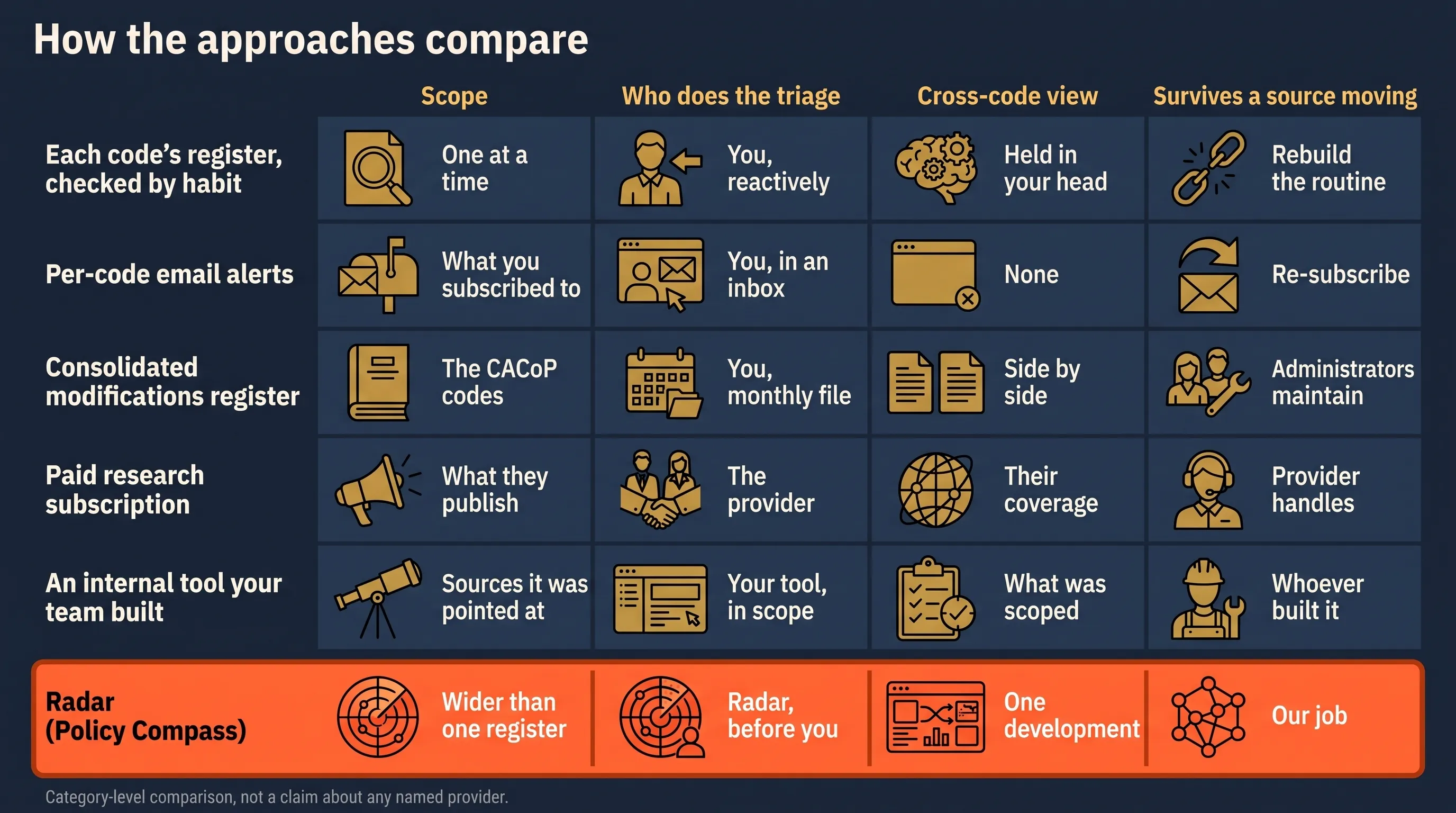
Per-code registers, email alerts and Radar: how the approaches compare
The approaches differ less in what they cover than in who does the triage and what happens when a source moves.
| How you cover code change | Scope | Who does the triage | Cross-code view | Survives a source moving |
|---|---|---|---|---|
| Each code’s register, checked by habit | One code at a time, as wide as your habit reaches | You, per register and reactively | None - held in your head | You rebuild the routine |
| Per-code email alerts | Only what you subscribed to | You, in an inbox | None | You re-subscribe |
| A consolidated modifications register | Open modifications across the CACoP codes | You, from a monthly file | Codes side by side, as at that month | Maintained by the code administrators |
| Paid research subscription | What the provider publishes | The provider, for its whole readership | Depends on what the provider covers | Handled by the provider |
| An internal tool your team built | The sources it was pointed at | Your tool, within the scope it was given | What was scoped in at the time | Maintained by whoever built it |
| Radar (Policy Compass) | Wider than any one register | Radar, before it reaches you | Surfaced as one development | Keeping up with the map is our job |
Category-level comparison of approaches, not a claim about any named provider.
A routine built on a fixed list of websites carries a maintenance bill. Code reform is about to present it.
What Radar closes is the gap before your judgement: between something being published somewhere and you knowing it exists. Everything after that is your expertise, supported by research you can trace back to the source.
The bottom line
The consolidated registers that exist are monthly snapshots, and Ofgem is about to move the pieces underneath them.
Policy Compass watches across the codes with Radar, and triages what it finds against your business and your role.
Request a trial and stop going code by code. We set your team up, and Radar is working from that day - reading the day’s publications against your business and your role.
Sources
- Ofgem: energy codes (opens in new tab) - the list of codes, the role of code administrators and panels, and Ofgem’s role in deciding material changes (“Our role is to review and decide whether to approve or reject code changes that are submitted to us”; “Code bodies include administrators, panels and working groups. They decide on simple changes”); consulted 5 August 2026.
- Ofgem: Implementation of energy code reform, second decision (opens in new tab) (6 March 2026) - decisions on the modification process, the Stakeholder Advisory Forum and cross-code working. Three-phase delivery and the November 2026 phase 1 go-live: para 1.7. Phase 2 code manager selection, the call for expressions of interest and the consolidation workgroup: paras 1.24-1.25 and 7.56. Phase 1 code manager candidates: para 2.238. BSC and REC outside first-phase consolidation: para 5.8. Cross-code consultation position and decision: paras 2.121 and 2.132. The CCSG change tracker, proposed in the code text: paras 2.137 and 2.146. Consulted 5 August 2026.
- Ofgem: Implementation of energy code reform, template code text (opens in new tab) - the consultation on the implementing code text, published 6 March 2026, closed date 17 April 2026, status “Closed (awaiting decision)”; consulted 5 August 2026.
- Code Administration Code of Practice: codes (opens in new tab) and Central Modifications Register (opens in new tab) - the register “provides a consolidated list of all the open Modifications across all the CACoP Codes. We review and update the register once a month”, published as monthly spreadsheets. The Horizon Scanner (opens in new tab) page states “We review and update this list twice a year”, and the version published there is labelled “CACoP Horizon Scanner (last updated: 8 September 2023)”. Consulted 5 August 2026.
- NESO: industry codes (opens in new tab) - the connection and operational codes and their change processes; consulted 5 August 2026.
- Retail Energy Code (opens in new tab) - the retail arrangements and the cross-code steering group; consulted 5 August 2026.
- Smart Energy Code Company (opens in new tab) - the smart metering code and its modification register; consulted 5 August 2026.