


The best way to keep up with energy regulation is to watch the source landscape, filter what matters, route it to the right person and research the nuance from authoritative material.
It does not work when the answer is just “read more”.
That applies whether the team is two people or twenty. Smaller teams are stretched because there are fewer hands. Larger teams are stretched because the business usually spans more regulatory surface: supply, generation, flexibility, settlement, codes, retail, networks, commercial strategy and operations. The pressure scales differently, but the answer is the same: build capacity around the people whose judgement actually matters. It is worth being honest about why this matters: the cost of missing a single regulatory change is rarely the reading time, it is the consultation answered too late - or drafted from a blank page - or the charging change you did not model.
TL;DR
- The best way: teams keep up with energy regulation by separating the work into monitoring, filtering, routing and deep research - not by adding more inboxes.
- The real bottleneck: the issue is regulatory surface area, not team size. Larger energy businesses often need more people because they cover more markets.
- The force multiplier: Policy Compass turns expert judgement into higher coverage by watching across UK energy’s regulators and industry codes, then interpreting each signal by business and role.
- Where AI fits: ChatGPT, Claude, Gemini and similar assistants help once you know what to ask. Policy Compass is built for the step before that.
- What stays human: regulatory interpretation, response strategy and commercial judgement stay with the team. The tool gives them more room to use it.
What is the best way to keep up with energy regulation?
The best way to keep up with energy regulation is to treat regulatory change as an operating model, not an inbox problem.
Regulatory intelligence is the layer above raw monitoring: it watches source material, interprets each development against a business and role, and gives the team a source-grounded view of what needs attention.
That distinction matters. A feed can tell you that something exists. A newsletter can tell you what happened. A general-purpose assistant can help summarise a document once someone points it at the right material. Each is a genuine alternative to an analyst subscription - and each leaves a different gap.
None of those automatically answers the harder workflow question:
Who inside this business needs to care, and why?
For Policy Compass, the model is deliberately practical:
- Monitor authoritative sources continuously: watch across UK energy’s regulators and industry codes so the team is not dependent on someone manually checking each source surface.
- Filter every signal against the business: interpret each development against the organisation’s market participation, licence position, customer segments and operating model.
- Route the signal by role: decide which person needs the signal first, because the same publication can matter differently to codes, retail, commercial, flexibility or operations roles.
- Research from the source trail: move from the surfaced signal into the underlying documents, with each claim traceable to authoritative material.
- Leave judgement with the team: use the intelligence layer to create capacity, then let regulatory professionals apply their own interpretation and market judgement.
That last step matters most. Regulatory people are not short of judgement - their interpretation, experience and market sense are the valuable part. The expensive part is getting through the volume before that judgement can even be applied.
Why the bottleneck is regulatory surface area, not team size
Regulatory teams feel stretched when the regulatory surface area grows faster than the team’s ability to triage it.
That is not just a small-team problem.
A small supplier may have one or two people covering a wide patch. A large supplier may have a larger regulatory function, but the business itself often covers more ground: retail supply, generation, flexibility, balancing, settlement, customer operations, digital, pricing and code change. More people helps, but it does not remove the surface area.
The source landscape is fragmented by design. Ofgem’s consultations page (opens in new tab) carries consultations, calls for input and responses that develop policies or changes. DESNZ’s consultation hub (opens in new tab) has its own open consultation surface and closing dates. Ofgem’s energy code reform page (opens in new tab) says the aim of reform is to reduce complexity and make rules easier for companies in energy markets to understand. NESO’s Grid Code modifications page (opens in new tab) lists current and concluded modifications by ID, status and last update, and points users to a tracker with purpose, affected stakeholders and review stage.
Those are only examples. They are not the full source landscape.
The industry codes are the sharpest version of that fragmentation: each keeps its own change record, in its own format, and the consolidated views that exist are periodic snapshots rather than a live picture.
The process burden is real too. Elexon’s BSC Change Process Guidance Note (opens in new tab) says a Modification will typically take six to eight months to reach a final decision, before implementation time is added. REC’s June 2024 change-process update (opens in new tab) said more change requests were implemented than ever before in 2023/24, with over 55 new requests raised, while stakeholders still identified the process as too slow - and RECCo’s own review found the volume of change higher than estimated.
The point is the shape of the work. Each surface has its own cadence, taxonomy, process and context. A regulatory team does not just need to notice that a document exists. It needs to work out whether it is relevant, who owns it internally, how urgent it is, what source material sits underneath it and what judgement still needs to be made.
That is the bottleneck.
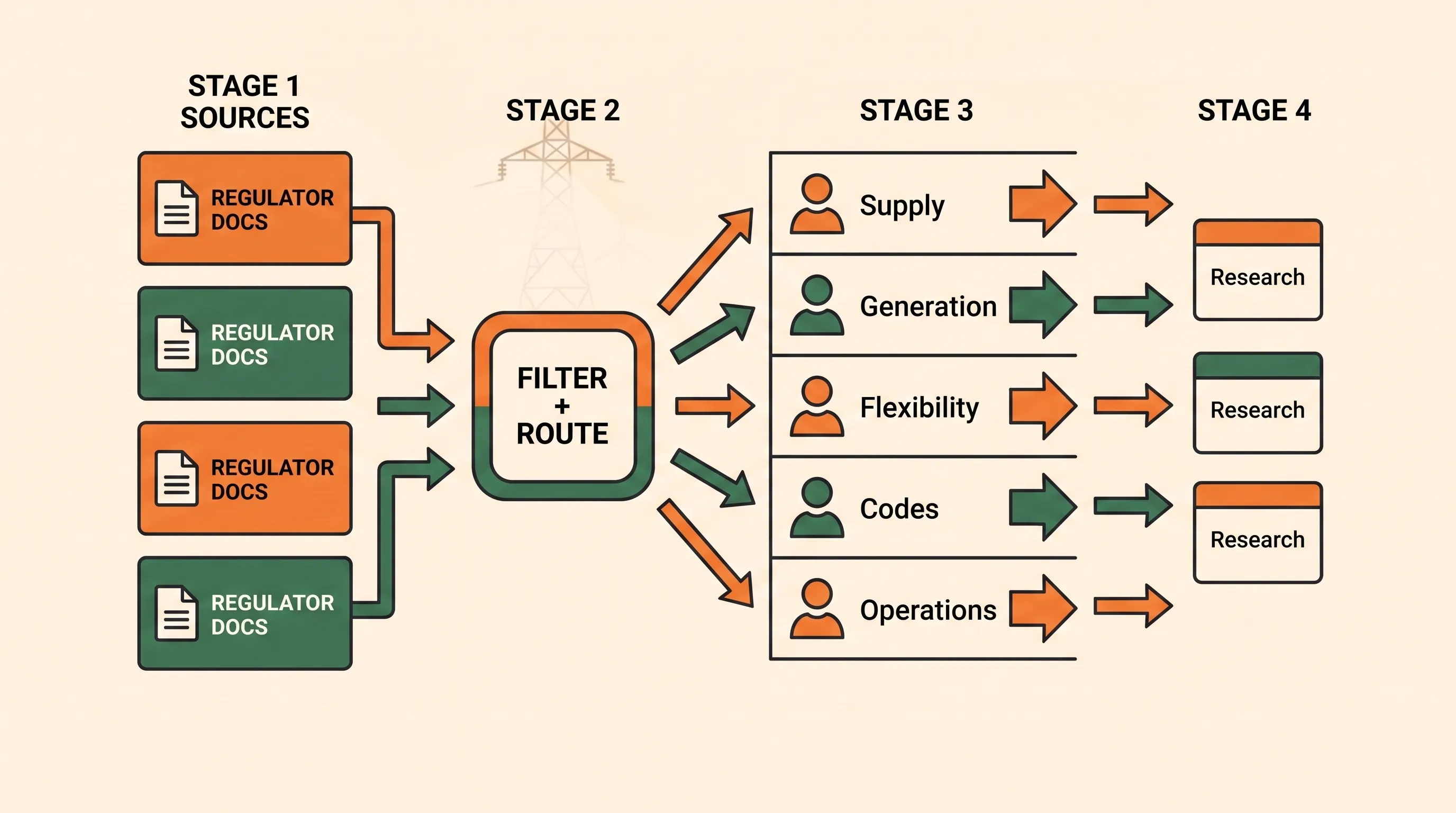
Why larger regulatory teams still feel stretched
Larger regulatory teams are not immune to volume. They inherit a wider map.
In a multi-market energy business, the same publication can touch several internal owners at once. A codes specialist may care about process and implementation route. A retail regulation lead may care about customer impact and response position. A flexibility team may care about market participation. Commercial teams may care about product design, pricing or client consequences.
One signal.
Different work.
That is why a larger team does not need a generic feed with more recipients. It needs better routing. The question is not simply “does this matter to the company?” It is “which part of the company does this matter to first?”
This is where the role layer changes the operating model. The business profile tells Policy Compass what the organisation is. The role profile tells it what the person does. Radar can then rate and explain the same signal differently for the people who actually own the work.
That matters in large teams because specialisation creates handoffs. It matters in small teams because the same person may wear several hats. Different structure, same pressure.
What should regulatory teams stop doing manually?
Regulatory teams should stop treating first-pass triage as a fully manual professional task.
The judgement should stay human. The mechanical parts should not.
| Workload | Manual monitoring | Generic AI assistant | Analyst publications | Policy Compass |
|---|---|---|---|---|
| Finding source signals | Depends on people checking sources and inboxes | Only when prompted or configured around a task | Curated by the publisher | Radar runs in the background across UK energy’s regulators and industry codes |
| Business relevance | Held in someone’s head | Must be explained in the prompt | Usually broad market framing | Persistent business profile |
| Role routing | Informal, often after triage | Usually absent unless prompted | Same output for all readers | Role-aware priority and explanation |
| Source discipline | Strong when the team has time | Depends on prompt and tools | Strong, but editorially selected | Authoritative source material with citations attached |
| Deep follow-up research | Manual reading and cross-referencing | Useful once the question is known | Limited to the publication | Research follows the source trail and cites each claim |
| Best use | Final judgement and response strategy | Drafting, summarising and exploring | Market context and commentary | Monitoring, filtering, routing and source-grounded research |
Category-level comparison, not a claim about any named provider.
This is the practical split. Let people do the work only people can do: interpretation, stakeholder handling, response strategy, judgement calls, commercial trade-offs.
Let the system absorb the repeatable load around it.
The force-multiplier model: monitor, filter, route, research
A regulatory force multiplier does not replace the regulatory function. It increases the amount of ground the function can cover with the same judgement.
That is the model we are building around Policy Compass.
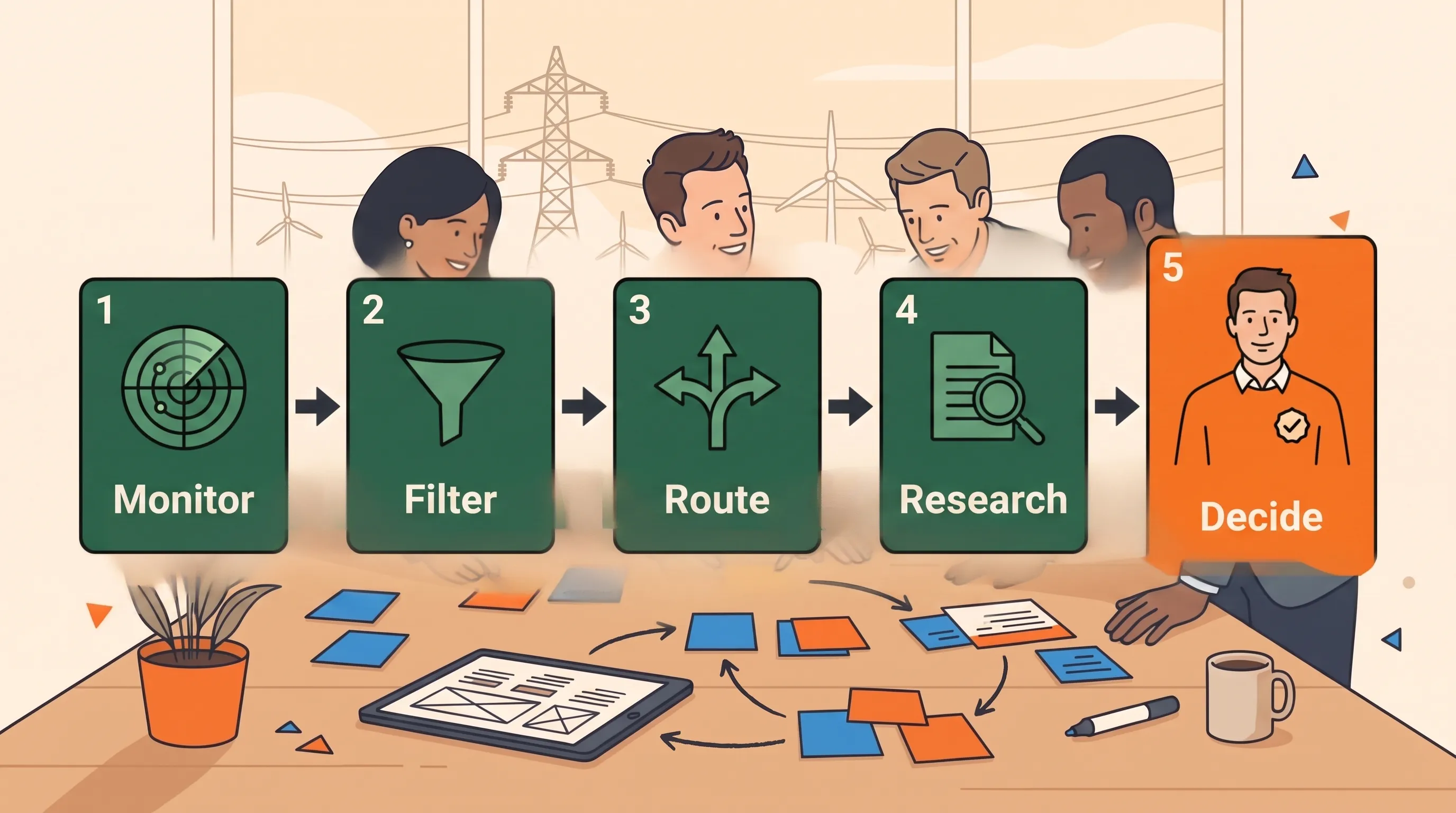
Monitor: Radar runs in the background, watching across UK energy’s regulators and industry codes. The team is no longer dependent on someone manually remembering every source surface.
Filter: each signal is interpreted against the business profile. A development that matters to a supplier, consultancy, flexibility provider or network-facing team will not land the same way for each organisation.
Route: each signal is then interpreted against the user’s role. The same development can be a high-priority interruption for one person and background context for another.
Research: once something matters, Research becomes the deep assistant. It follows the source trail into the underlying material and keeps claims attached to citations.
Decide: the regulatory team still owns the final call.
That final step is not a caveat. It is the point.
The more useful the intelligence layer becomes, the more expert time should move toward interpretation. Not admin. Not inbox archaeology. The work where experience actually compounds.
Where general-purpose AI helps - and where it stops
General-purpose AI is useful for regulatory teams, but it is not an operating model for regulatory intelligence.
ChatGPT, Claude, Gemini, Grok and similar assistants can help draft a response structure, summarise a document, compare paragraphs or turn rough notes into a clearer briefing. Used carefully, that is valuable.
The limit is structural. A general-purpose assistant helps once someone knows what to ask and where to point it. Energy regulation monitoring starts earlier: what changed, where did it come from, which profile does it touch, who inside the team owns it, and what source material supports the answer?
That is the difference we covered in Policy Compass vs ChatGPT for UK energy regulatory research. The model matters. The Regulatory Harness around it matters more.
Policy Compass is built around the Regulatory Harness: authoritative source-gathering, source-constrained research, business context, role context and citations attached to the claims they support.
It is narrower on purpose.
What this means for suppliers, consultancies and flexibility teams
The force-multiplier model shows up differently by team type.
For energy suppliers, the pressure is breadth. A larger supplier may have more regulatory people, but it may also span supply, generation, flexibility, customer operations, settlement and codes. Policy Compass helps route source signals to the person whose work is actually affected.
For energy consultancies, the pressure is portfolio shape. The same development may matter differently for each client. A generic summary is not enough when one client needs a formal response position and another only needs context.
For flexibility providers, the pressure is pace and adjacency. A source signal may sit in code change, market design, retail or system operation, while the business impact lands across several teams.
The common thread is not size.
It is coverage without losing judgement.
Sources
- Ofgem consultations (opens in new tab) - consulted 7 July 2026.
- DESNZ consultation hub (opens in new tab) - consulted 7 July 2026.
- Ofgem energy code reform (opens in new tab) - consulted 7 July 2026.
- Elexon BSC Change Process Guidance Note (opens in new tab) - consulted 7 July 2026.
- REC change-process update (opens in new tab) - published 24 June 2024, consulted 7 July 2026.
- NESO Grid Code modifications (opens in new tab) - consulted 7 July 2026.
The bottom line
The best way to keep up with energy regulation is not to ask regulatory teams to read faster.
It is to give them a system that watches the market, filters the signal, routes it by role and keeps the source trail intact. Policy Compass does that around the people who already know the domain. Request a trial and put it on your own regulatory patch - a free, team-wide trial with full access.
More judgement, less drag.