


Every consultation you skip is a market shaped without you.
In UK energy, consultation responses are one of the few direct levers you have on the rules that decide your market - what you can trade, how you get paid, what you have to build. Responding is how you get your read of the market in front of the people writing those rules. The question was never whether it is worth doing. It is that there are so many, from so many bodies, and every one starts from a blank page.
So we built the part that gets you a first draft worth refining - one built on your house ethos, grounded in the sources - instead of a blank page, or a generic draft you would only throw away.
TL;DR
- Why it matters: consultation responses are how a UK energy business shapes the rules that set its commercial position - credibility with the regulator, and a hand in market design.
- The tax: an active team can field several consultations a quarter, each hours of work, most of it reassembling your own position from old responses.
- What we shipped: a feature that drafts a consultation response to around 80% - built on your house ethos and grounded in the authoritative sources.
- Why it isn’t ChatGPT: the difference is quality, not speed - a draft built on your house ethos and grounded in the right sources, not a fast generic one you throw away.
- Human in the loop: it does the draft; you own the position, the nuance and the final word - because that is where the expert judgement actually lives.
Consultations are where your market gets decided
For a UK energy business, a consultation response is not admin. It is one of the few direct inputs you get into the rules that determine your commercial and regulatory environment.
You already know this. It is exactly why the responses matter too much to phone in.
Three reasons they are worth the hours:
- Credibility. A track record of serious, considered responses builds your standing over time - the opposite of showing up only when something threatens you.
- Steering the market. The rules on what you can trade, how flexibility is paid, how charges fall are all shaped in consultations. If you are not in the conversation, they are shaped by those who are.
- Your nuance is the input the regulator lacks. Your specific, hard-won read of how a change plays out in the real market is exactly what a policy team drafting a rule does not have. A consultation is the channel to put it in front of them.
None of that is controversial to anyone who does this work.
The house position lives in people’s heads
The reason a consultation response takes hours to days is rarely the typing. It is reassembling your own position from scattered places.
Ask anyone who does this and it is the same story: the position is scattered across the last three or four responses, plus a stack of reference points that were never written down anywhere systematic. A lot of it lives in people’s heads - you had to be in the room on a particular Tuesday to know why the organisation argued a point the way it did.
Now multiply that by volume. Many active teams field several consultations a quarter; for the busiest, it runs into low double digits, from bodies as varied as Ofgem, DESNZ, Elexon and NESO, each with its own form and cadence. These are our own observations from the teams we work with, not a precise figure - but the shape is consistent, and the operating-model problem it creates is real.
And the downside is asymmetric. Skipping one is not a slow afternoon saved. It is a rule shaped without your input - one you then might have to live with.
What we built: consultation response drafting that sounds like you
Policy Compass’s consultation drafting produces a first draft of a consultation response - around 80% of the way there - built on your organisation’s house ethos and grounded only in authoritative sources. It is an editable draft your experts refine and make their own, not a finished submission.
Radar flags that a consultation is relevant to your business and your role; you start the draft straight from that item, so continuous monitoring feeds directly into the response. It learns your house ethos from your own prior responses - how you argue, where you agree, how you push back - and drafts each answer in that voice, grounded in the authoritative source that governs the question. The result is a Word document your experts refine, format into the consultation’s own submission template, and make their own.
Consultations arrive in every shape - a Yes/No form, an Agree/Disagree/Abstain impact assessment, free-text comment boxes, prose Q&A. The formatting is the easy part you handle; the grounded answer in your ethos is the hard part we draft.
One thing we were deliberate about: it keeps a long response internally consistent, so an answer to question 14 does not contradict question 3. Everything that needs judgement stays with you - what to include, what to hold back, and the final position.
What it does not do is decide your position for you. It clears the reassembly so the expert work starts from a draft, not a blank page.
Why this isn’t just ChatGPT with a prompt
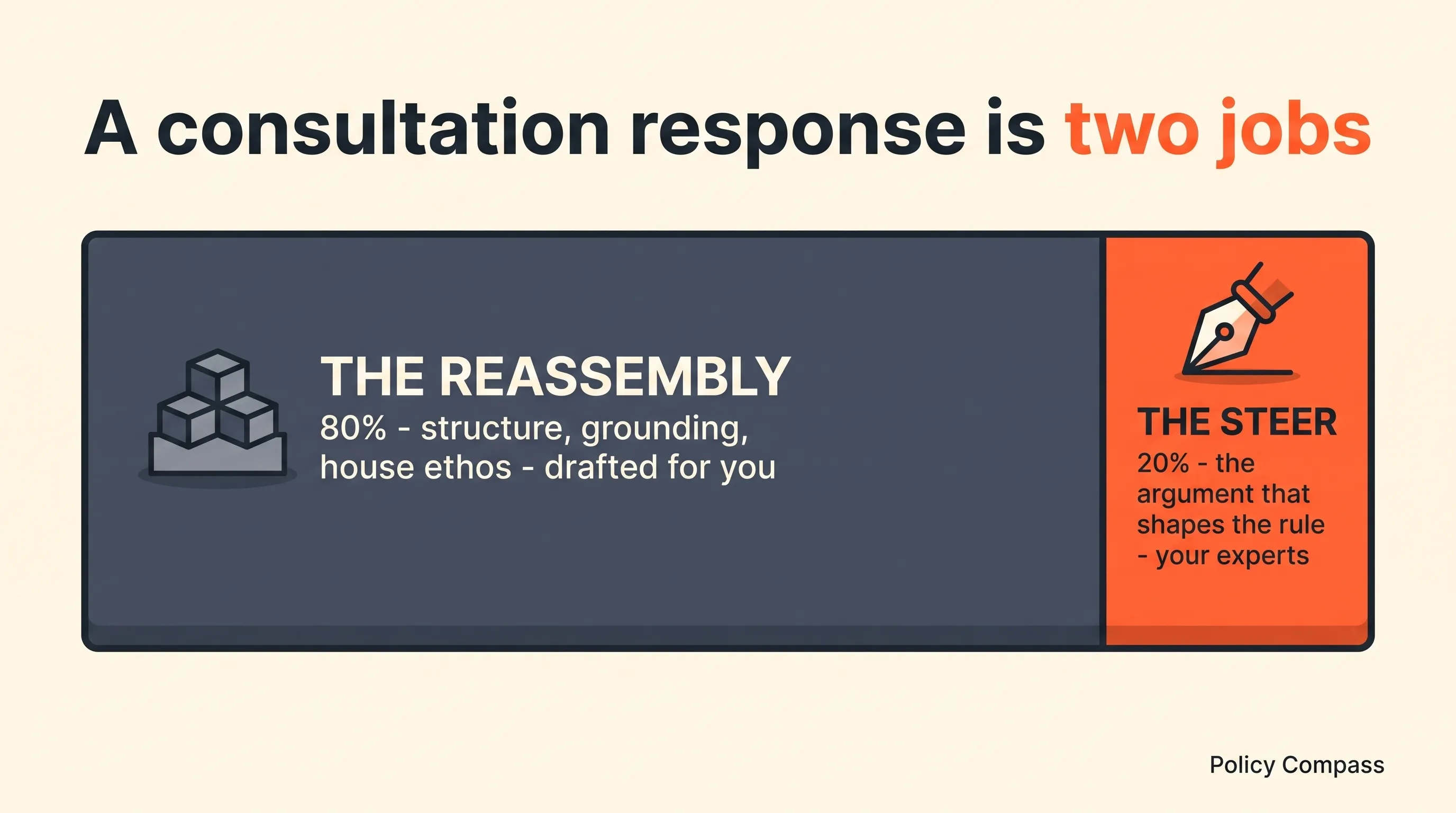
The hard part of a consultation response was never generating words. A general assistant (ChatGPT, Claude, Gemini, Grok or similar) is very good at words. What breaks is everything underneath them - whether the answer is grounded in the right source, and whether it argues your position rather than a generic one.
If you have tried ChatGPT on a consultation, you already know the failure mode. It produces something fluent and confident - and, in our experience, sometimes about the wrong thing entirely. We have watched one answer a NESO consultation as though it were about a completely different service. Fluent, plausible, wrong. A fast draft you have to throw away is not a head start. Speed was never the problem.
The difference is not the model. It is what surrounds it - the harness that makes a draft worth refining. Two things a general assistant does not have.
First, your house ethos: it has learned how your organisation actually argues, from your own prior responses, so the draft takes your positions rather than inventing plausible ones. Second, grounding: every answer is built from the authoritative source that governs the question - so when you check it, and you will check it, it holds up. That is the difference between a draft you bin and one you refine.
| What actually decides the answer | ChatGPT and other general assistants | Policy Compass |
|---|---|---|
| Argues your position | Generic, unless you re-explain it every time | Built on your house ethos, learned from your prior responses |
| Grounded in the right source | Confident, but can answer about the wrong thing | Every answer built from the authoritative source that governs the question |
| Consistent across a long response | Per-prompt; easily contradicts itself | Internally consistent across the whole response |
| Worth refining, not rewriting | A fast draft you often throw away | An editable draft your experts make their own |
Category-level comparison; the points about general assistants are our own observations, not claims about a specific product.
The 20% is where you win
The point of drafting to 80% is not to take the writing off your desk. It is to move where your time goes.
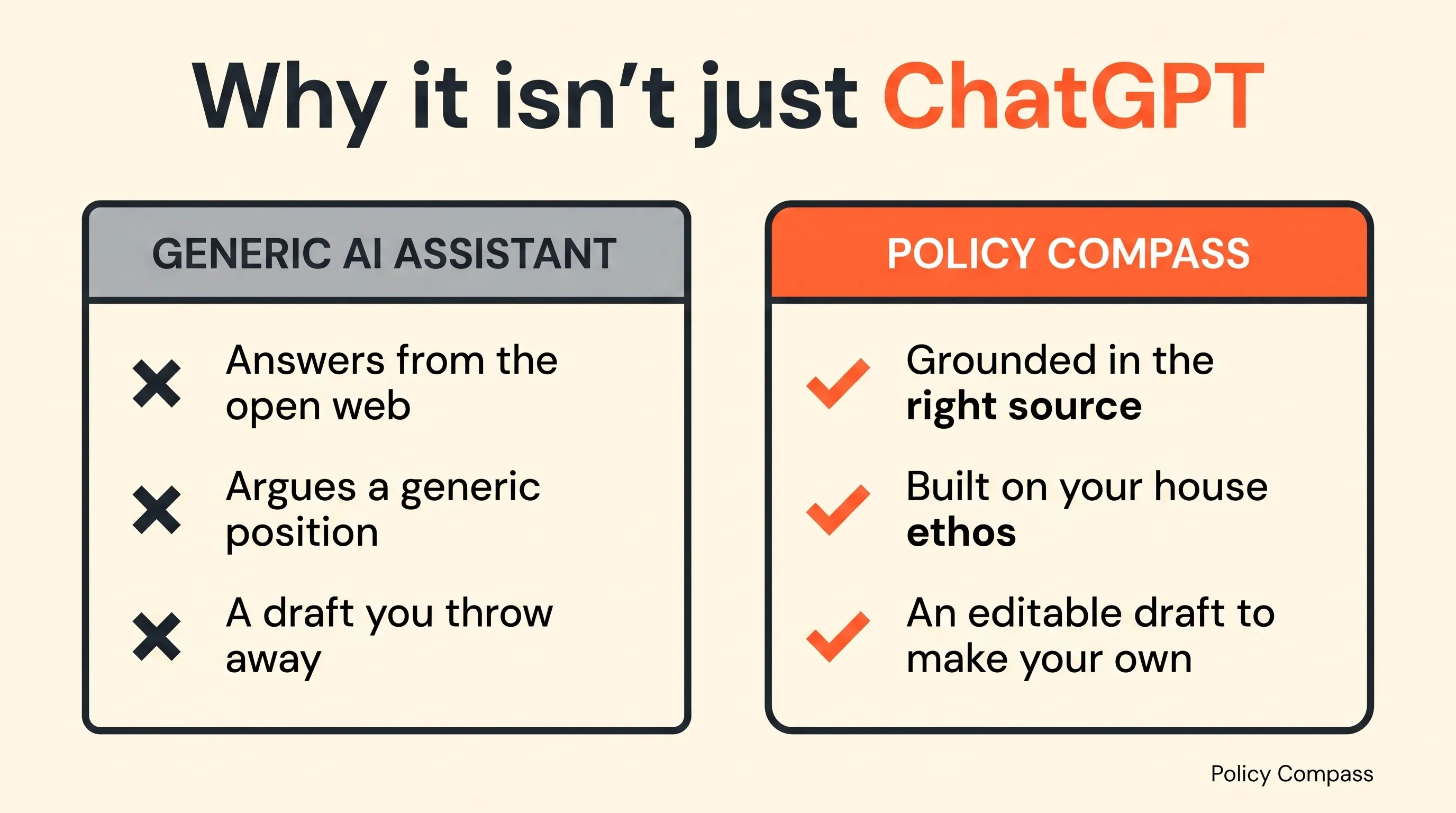
A consultation response is really two jobs. There is the reassembly - pulling your position together, grounding it, and getting a solid first draft down, all the work you would otherwise redo from scratch each time. And there is the steer - the specific argument, the commercial position, the line pitched at the person who will read it. The reassembly is the 80%, and it still has to be done well. The steer is the 20%, and it is the whole point: it is your experts’ judgement, and it is the only part that actually shapes the rule. Every hour spent on the reassembly is an hour not spent on the steer.
The bar we hold it to is not “good enough to send”. It is “good enough that a team’s own regulatory lead reads the draft and thinks, that sounds like us” - a genuine head start they trust, with a human owning the final position. Anything less is not worth refining, and we know it.
The bottom line
Consultation responses are how you get a say in the rules that shape your market. The tax was never the value of doing them - it was starting each one from a blank page, or from a generic draft you could not trust. Now the reassembly is a high-quality draft built on your house ethos, and your experts’ time goes to the steer - the 20% that actually shapes the rule. Request a trial and put it on your own consultation backlog - a free, team-wide trial with full access.
Because every consultation you answer well is a market you helped shape.
Sources
- Ofgem consultations (opens in new tab) - open consultations and calls for input, with closing dates; consulted 27 July 2026.
- How Ofgem consults (opens in new tab) - how consultations and calls for input work; consulted 27 July 2026.
- Consultation principles guidance (UK Government) (opens in new tab) - how public consultations run to a fixed window; consulted 27 July 2026.
- NESO industry codes (opens in new tab) - the code framework much energy-market change is consulted through; consulted 27 July 2026.