


The real cost of missing a regulatory change is rarely the hour you would have spent reading it. It is the consultation you did not respond to before the window closed, the charging change you did not model into next year’s pricing, the licence obligation you heard about second-hand. The reading was never the expensive part.
So we do not think of Radar as a time-saver. We think of it as insurance.
A time-saver has to save you time to be worth it. Insurance does not. It has to be there the one time it matters.
TL;DR
- The reframe: the value of continuous regulatory monitoring is not the hours it saves. It is the miss it prevents. That is insurance, not productivity.
- The invisible risk: you do not find out what you missed until it is too late to act on it. The most expensive miss is the one you never see.
- Why it resists a number: the cost of missing a regulatory change is its probability times its consequence. The probability is unknowable and the consequence is large. That asymmetry is exactly what insurance is for.
- What Radar does: monitors across UK energy’s regulators and industry codes, then triages every signal against your business and your role, so the change that matters lands and the noise does not.
- The economics: it does not have to save you time to pay for itself. It has to catch one thing.
The risk you never see coming
The dangerous misses are not the ones you catch late. They are the ones you never catch at all.
You already know what a closed consultation window costs you, what an unmodelled charging change does to a price, what it feels like to hear about an obligation from a client rather than from the source. We are not going to explain your own job back to you. The point is narrower than that: the misses that hurt most are invisible at the time they happen. There is no alert for the thing you did not know to look for.
The comforting assumption is that anything genuinely important would reach you somehow. A colleague forwards it, it comes up on a call, it is big enough that you would not miss it. Usually true.
The problem is “usually”.
Manual monitoring works right up until the week it does not - the week the volume spikes, the key person is on leave, or the change that matters is buried three levels down in a code body’s workstream rather than announced on a regulator’s front page. None of that is a failure of expertise. It is a failure of coverage, and coverage is a volume problem, not a judgement problem. This is the same argument we made about why keeping up is an operating-model question, not a reading-speed one.
Why you can’t price the cost of missing a regulatory change
The reason this risk is so easy to under-fund is that it’s very difficult to price.
The cost of a miss is roughly its probability multiplied by its consequence. Both terms are hostile to measurement. You cannot estimate the probability, because the whole nature of a miss is that it never entered your count - you cannot rate the likelihood of the changes you never saw. And the consequence is not fixed: most missed items cost nothing, a few cost a great deal, and you do not know in advance which is which.
An unknowable likelihood attached to an occasionally severe cost. That is not a productivity problem. It is the textbook shape of an insurable one.
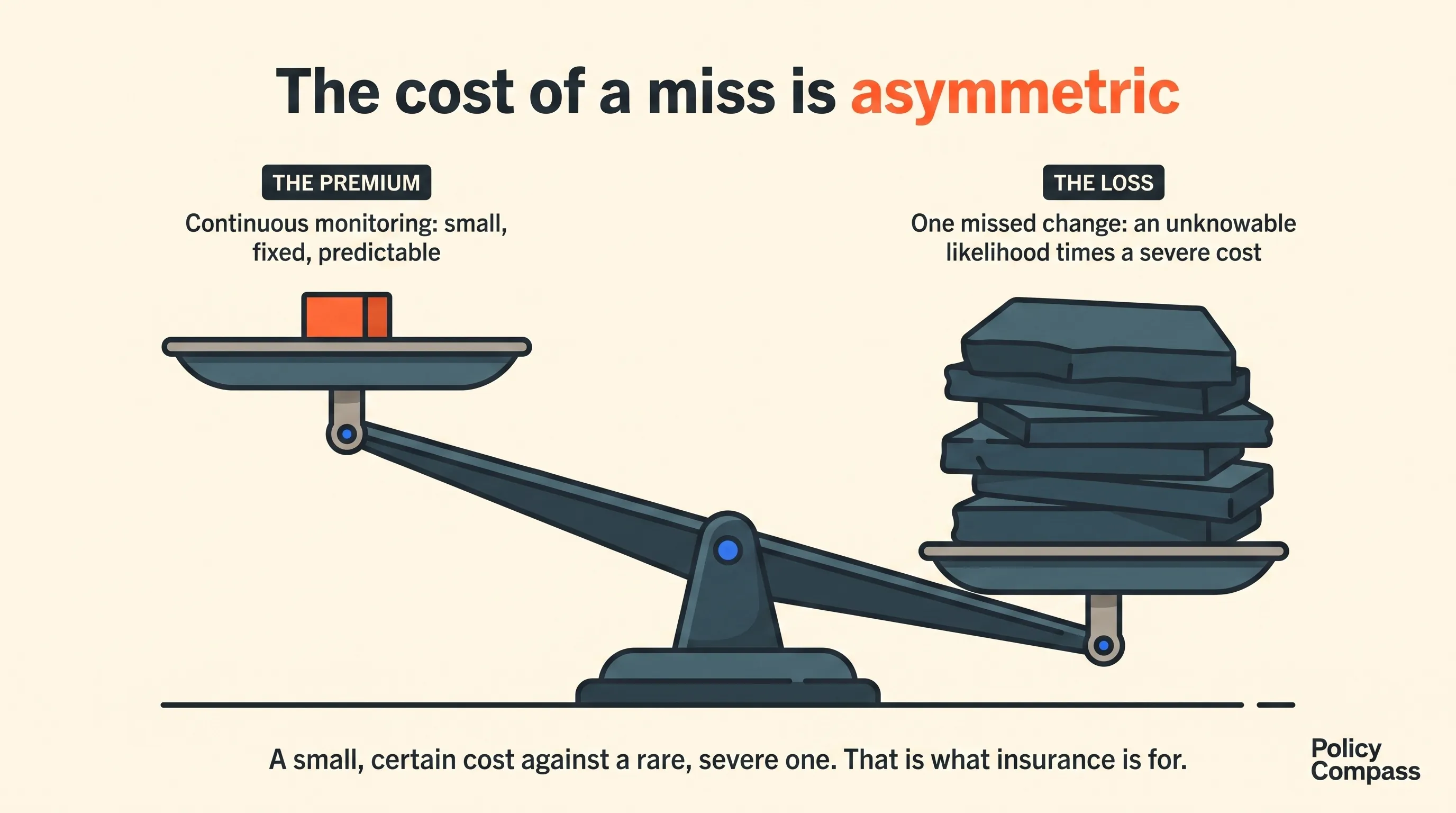
Energy businesses already act on this logic everywhere else. You carry professional indemnity cover without demanding proof you will be sued this year. You hold reserves against outcomes you hope never arrive. Nobody asks those line items to save time. They exist because a rare, large, unpredictable loss is worth paying a small, predictable amount to cover.
The risk of missing regulatory change has that exact profile. It just rarely gets its own line item - because it hides inside “we keep on top of it”, and everyone does, right up until the week nobody did.
What “insurance” looks like for regulatory change
Radar is Policy Compass’s continuous monitoring layer. It watches developments across UK energy’s regulators and industry codes, assesses each one against your business and your role, and surfaces the ones that matter to you - filtering out what does not apply, ranking what does, and explaining why.
That last part is what makes it insurance rather than noise.
More alerts are not protection. An unfiltered feed of everything every body publishes is not cover against a miss - it is a larger haystack, and misses live in haystacks. The comforting inbox full of unread notifications is where the important one goes to die.
So the job is triage, not volume. Radar filters out what does not apply to you, ranks what does by how much it matters, and tells you why it is relevant to your specific business and your specific role - because the same code modification can be a priority for the person covering settlement and background noise for the person covering retail. That role-awareness is the part generic monitoring does not have, and it is why we built the role layer.
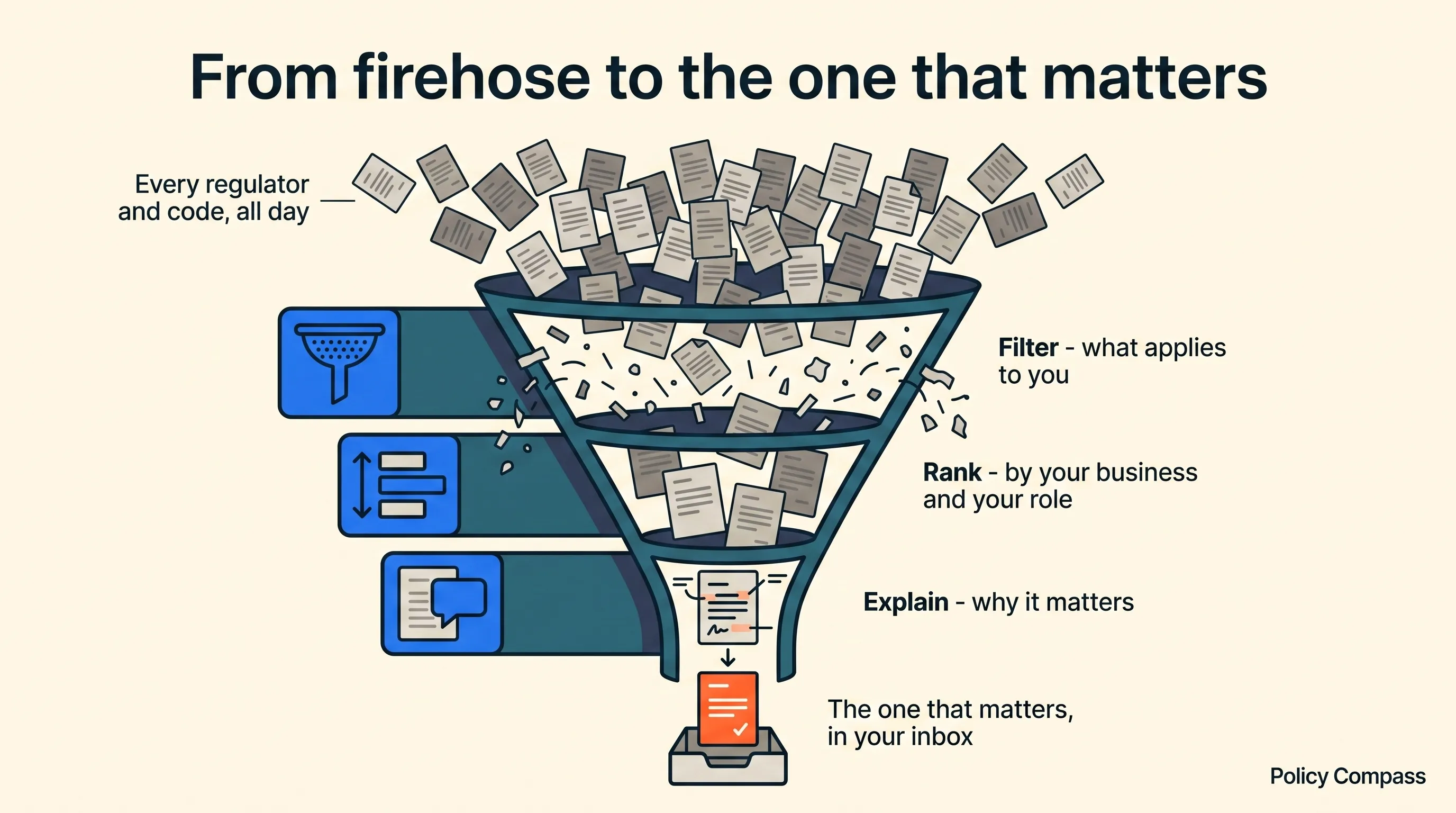
Nothing here removes your judgement. It removes the exposure that sits before your judgement can be applied - the gap between a change being published and you knowing it exists. That gap is the whole risk, and it is the part that scales badly with volume and headcount. It is also the part Policy Compass is built to close.
It doesn’t have to save time to pay for itself
Here is the test we would actually apply. Forget the hours. Ask what one miss would cost you, and how likely you are, across a year, to have exactly one.
For most active market participants the honest answer to the second question is “more likely than we would like to admit”. Which means the tool clears its own bar the first time it catches something real. A seat costs a fraction of one regulatory analyst’s salary, and a single missed charging change, or a consultation answered a day too late, can easily cost more than a year of the subscription. You do not need the time savings for the maths to work. They are a bonus on top of the actual product, which is not missing things.
There is a genuine limit worth stating plainly. Insurance you never claim on can feel like money spent on nothing - and a tool whose main value is a miss that did not happen is, by design, quiet about its wins. You will notice the afternoon it saves you. You will rarely notice the quarter it saved you, because the bad outcome simply never arrives. That is the nature of the category, and we would rather name it than pretend every login delivers a visible jolt of value.
| How teams cover regulatory change | Catches what applies to you | Ranks by relevance | Explains why it matters | Insurance against a miss |
|---|---|---|---|---|
| Manual source sweeps | Depends on who is checking, and when | Held in someone’s head | Yes, when there is time | Strong until volume or absence breaks it |
| Free regulator email alerts | Only the sources you subscribed to | No | No | A feed, not a filter |
| Analyst publications | Broad market framing | Editorially, for a general reader | Yes, at market level | Partial - not contextual to you |
| Radar | Across UK energy’s regulators and industry codes | By your business and your role | Yes, per signal | The whole point |
Category-level comparison, not a claim about any named provider.
When you do engage, engage from evidence
Catching the change is the insurance. What you do next is the return on it.
Once something lands, Research takes you from the surfaced signal into the underlying material, with every claim traceable to an authoritative source - the actual modification, the settlement document, the consultation text. So you are not just alerted early. You can respond from evidence, with an answer you could put in front of a board and defend line by line. This is the source-grounded half of the Regulatory Harness: monitoring catches it, cited research lets you act on it.
Not missing the change buys you the chance to respond well. Responding well - drafting the consultation response that shapes the rule - is where your expertise actually compounds.
The bottom line
You cannot price the miss you never see. But you know it is the expensive one - the closed window, the unmodelled change, the obligation that reached you late. Continuous monitoring is insurance against exactly that, and insurance is not judged on the time it saves. It is judged on being there the one time it matters.
Radar does not have to save you an hour. It has to catch one thing. The reading was never the expensive part. Request a trial and put it on your own regulatory patch - a free, team-wide trial with full access.
Sources
- Ofgem consultations (opens in new tab) - open consultations, calls for input and their closing dates; consulted 27 July 2026.
- Consultation principles guidance (UK Government) (opens in new tab) - how public consultations run to a fixed window; consulted 27 July 2026.
- Department for Energy Security and Net Zero (opens in new tab) - a primary source of energy policy consultations; consulted 27 July 2026.
- National Energy System Operator (NESO) (opens in new tab) - system and market change affecting network and flexibility participants; consulted 27 July 2026.