


The alternatives to an analyst subscription for UK energy regulatory intelligence come down to four operating models: manual monitoring, general-purpose AI, analyst publications, and AI-native regulatory intelligence. The right one depends less on price than on a single question - do you need generic market commentary, or intelligence contextualised to your own business?
Most teams already run some mix of the first three. The gap they leave is the same one, every time: someone still has to work out what this week’s change means for you.
TL;DR
- The four alternatives: manual monitoring, general-purpose AI (ChatGPT and the rest), analyst publications, and AI-native regulatory intelligence. Each trades off coverage, context, timeliness and cost differently.
- What an analyst subscription is good at: broad market commentary, scenarios and forecasts. What it is not built for: telling you what a specific change means for your specific business, the day it lands.
- The real question: not “which report is best?” but “who does the translation from market-wide framing to my desk?”
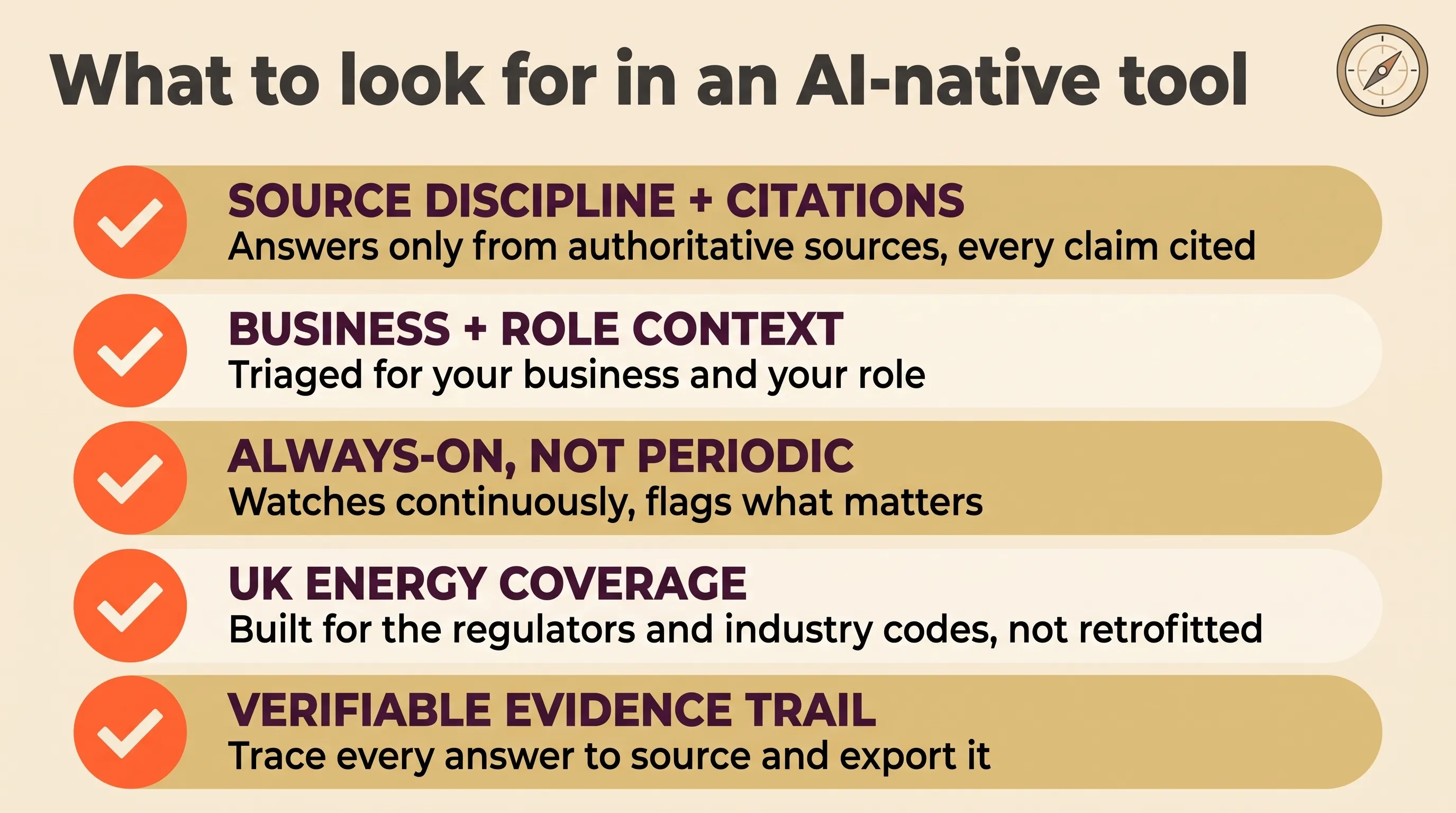
- What to look for in an AI-native tool: source discipline with citations, business and role context, continuous monitoring, genuine UK energy coverage, and a verifiable evidence trail.
- Build vs buy: building your own is a maintenance commitment most teams underestimate. We know - we built ours first.
What are the alternatives to an analyst subscription?
There are four broadly different ways a UK energy team keeps up with regulatory change, and they are not all trying to do the same job.
Manual monitoring - people checking Ofgem, DESNZ and the code bodies directly. General-purpose AI - ChatGPT, Claude, Gemini and the rest, used to summarise and draft. Analyst publications - subscription reports and newsletters that tell you what happened across the market. And AI-native regulatory intelligence - a system that watches the authoritative sources continuously and interprets each change against your business. Policy Compass is one of these.
Regulatory intelligence is the layer above raw monitoring: it watches authoritative source material, interprets each development against a specific business and role, and keeps a cited trail back to the original document. It is not compliance software - it tells you what is changing and what it means, not whether you are compliant.
| What matters | Manual monitoring | Generic AI (ChatGPT, Claude, etc.) | Analyst subscriptions | AI-native intelligence (Policy Compass) |
|---|---|---|---|---|
| Coverage | Only what someone checks | Only what you prompt | What the publisher curates | Continuous across UK energy’s regulators and industry codes |
| Business context | Held in someone’s head | Must be re-explained each time | Broad market framing | Persistent profile of your business and role |
| Timeliness | As fast as your team | On demand, when asked | Periodic - the publisher’s cadence | Continuous, flagged when it matters |
| Source discipline | Strong, if you have the hours | Open web; can invent sources | Authoritative, editorially selected | Authoritative sources only, every claim cited |
| Cost model | Headcount | Per seat or usage | Recurring, often modular | Per seat (£400/month, or £320/month billed annually) |
| Best for | Final judgement | Drafting and summarising | Market commentary and forecasts | What changed, what it means for you, and what to do |
Category-level comparison of operating models, not a claim about any named provider.
No single row decides it. Read the context and timeliness rows together, though, and the analyst-subscription trade-off comes into focus.
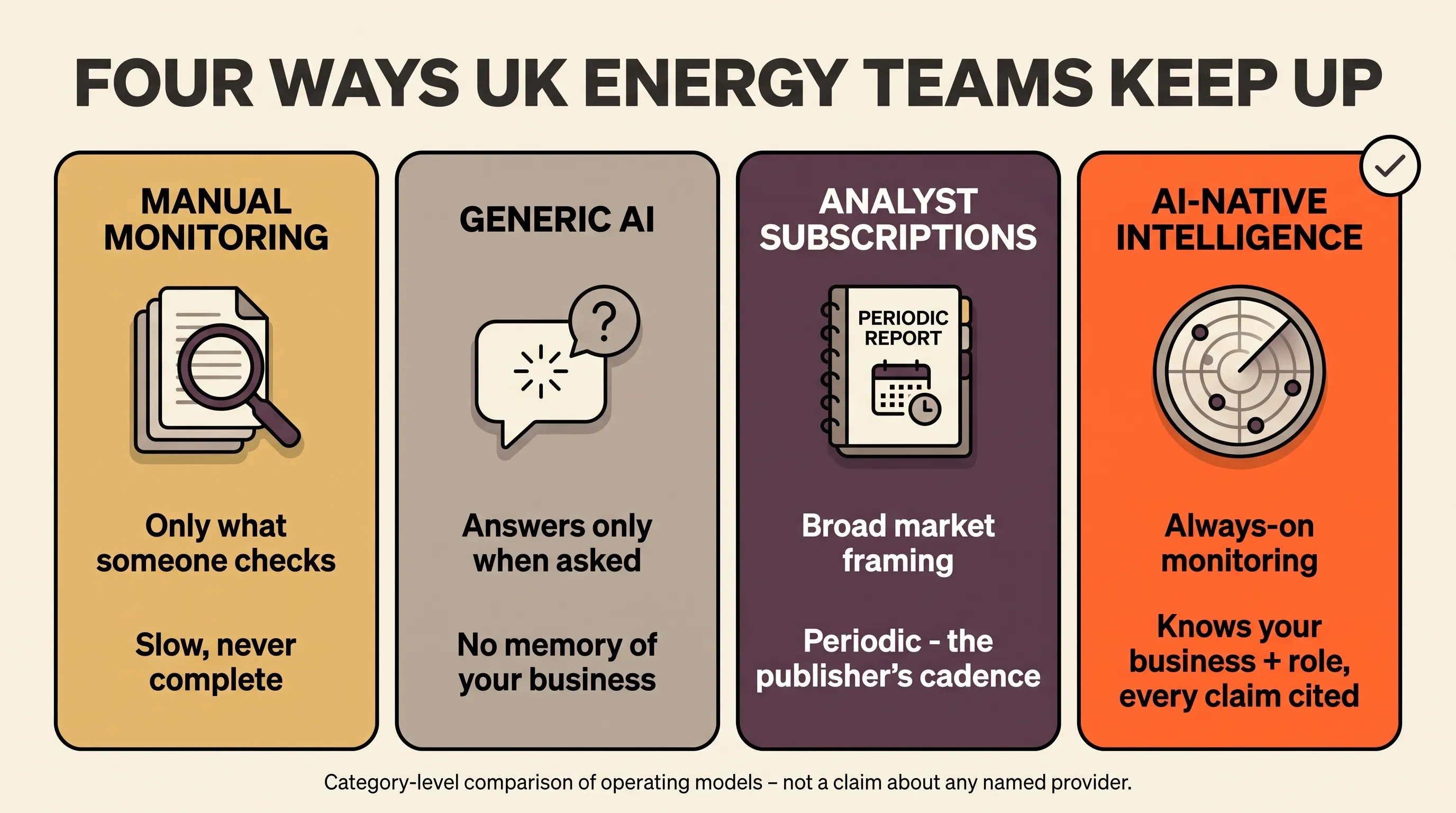
What an analyst subscription does well - and where it stops
Be fair to the model - it earns its place. A good analyst subscription gives you something real: market-wide commentary, price and scenario forecasting, and the kind of framing that helps a leadership team see round corners. If what you need is a considered read on where the market is heading, that is what it is built for.
Where it stops is context and cadence.
Context. An analyst report is written for the market, not for you. It cannot know that you hold a particular licence, serve a specific customer segment, or that one clause matters to your codes lead and not your retail team. That translation - from general framing to your obligations - is left to you. In our experience it is also the most time-consuming part of the job.
Cadence. A subscription publishes on the analyst’s clock. Regulators publish on theirs. The two rarely line up.
The source landscape does not wait for a monthly digest. Elexon’s BSC Change Process Guidance Note (opens in new tab) says a Modification will typically take six to eight months to be progressed to a final decision, before implementation time is even added - a live process you need to track as it moves, not read about once it has settled. REC’s June 2024 change-process update (opens in new tab) reported more change requests implemented than ever before in 2023/24, over 55 new requests raised - and RECCo’s own review found the volume of change higher than estimated. Ofgem’s own code-reform programme (opens in new tab) exists to reduce that complexity. A periodic report is a snapshot of a system moving faster than the publishing cycle.
There is the commercial shape of it, too. Analyst subscriptions tend to be modular - you buy the feed or report you need, then pay again for the next market you move into. That works when your needs are stable. It works less well when your regulatory exposure is spreading faster than your budget cycle. Pricing is usually quote-based rather than published, and sold per service, so the total scales with the number of feeds and markets you need - not with the value you get from any one of them.
None of this makes the model wrong. It makes it one layer of a stack, not the whole answer. If all you were buying was a single feed, a continuous layer can replace it outright. If you rely on the market view and the forecasting, keep it - and add the contextual layer on top.
What to look for in an AI-native alternative
If you are weighing up the AI-native option, the label is doing a lot of work. Plenty of tools now put “AI” and “regulatory intelligence” in the same sentence. Fewer are built for UK energy, and fewer still are built to be trusted. Five questions separate the real thing from a wrapper.
- Source discipline, with citations. Does it answer only from authoritative UK energy sources - Ofgem (opens in new tab), DESNZ (opens in new tab), the industry codes - and cite every claim back to the primary document? If it draws on the open web, it can invent sources, and you cannot put it in a board paper.
- Business and role context. Does it hold a persistent profile of your business and your role, so the same change is triaged differently for you than for the wider market - and differently again for your codes lead than your retail team? That role layer is what turns a feed into intelligence.
- Continuous, not periodic. Does it watch continuously and tell you when something matters, scored and explained, rather than publishing on a fixed cadence you have to catch up with?
- Genuine UK energy coverage. Is it built for UK energy’s regulators and industry codes, or a global compliance tool retrofitted to the sector? The BSC, the REC and the Grid Code are not edge cases here - they are the job.
- A verifiable evidence trail. Can you trace every answer to its source and export it? Intelligence you cannot check is just a faster opinion.
Run those five questions across any shortlist and it thins out quickly.
Build or buy?
The other alternative is to build it yourself - wire up the source feeds, add a model, keep it running. It is a tempting path for a team with engineering nearby.
It is also a maintenance commitment most teams underestimate. Source sites change their structure, and code reform is moving which body publishes each code’s change record. New bodies and codes appear - Ofgem became the regulator for heat networks (opens in new tab) in Great Britain, with the first authorisation rules taking effect in January 2026: a new rulebook to cover, more or less overnight. The model needs grounding, or it drifts. What looks like a weekend integration becomes a system someone has to own.
We know, because we built our own version first - and the reason Policy Compass exists is that keeping it accurate, source-grounded and current turned out to be the whole product, not a side project. Buy when the tool is UK-energy-native, source-grounded and contextualised to your business. Build only if you are prepared to own it for good.
Where Policy Compass fits
Policy Compass is the AI-native option in that list - built for UK energy specifically, not a global regulatory tool pointed at the sector. That specificity is harder than it sounds.
Getting a model to answer accurately about an Elexon modification or a REC change request - and to do it in a way a fifteen-year regulatory professional will trust on a Monday morning - requires more than a well-crafted prompt. It requires a source discipline that keeps the model off the open web, a grounding architecture that ties every answer back to a primary document, a monitoring layer that watches the right places continuously, and a business and role context layer that knows how to translate a market-wide development into something specific to your licence, your team, and your exposure. That whole system - not just the model at the centre of it - is what Policy Compass is.
It watches across UK energy’s regulators and industry codes around the clock, rates each change from 1 to 10 for your business and your role, and answers research questions grounded only in authoritative sources - every claim cited, and exportable as an audit-ready evidence trail. The operating model underneath it is the one a good regulatory team already runs in its head. We built it so it runs without them having to.
It is not a replacement for an analyst’s market view - it will not out-forecast the market - and it is not ChatGPT with a UK energy prompt. It is the continuous, contextualised, source-grounded layer that sits between the raw sources and your judgement.
Sources
- Elexon BSC Change Process Guidance Note (opens in new tab) - consulted 8 July 2026.
- REC change-process update (opens in new tab) - published 24 June 2024, consulted 8 July 2026.
- Ofgem energy code reform (opens in new tab) - consulted 8 July 2026.
- Ofgem consultations (opens in new tab) - consulted 8 July 2026.
- Ofgem: new regulatory rules for heat networks (opens in new tab) - first authorisation rules effective 27 January 2026, consulted 8 July 2026.
- DESNZ consultation hub (opens in new tab) - consulted 8 July 2026.
The bottom line
The alternatives to analyst subscriptions are not really about swapping one report for another. They are about who does the translation from what changed to what it means for you - and who knows to look in the first place.
Manual monitoring puts that entirely on your team. Analyst publications hand you the market and leave your business to you. And generic AI falls short in two ways that careful prompting does not fix. First, coverage: one of our users told us they had not expected Radar to pick up a specific development - it did, and they used what it surfaced immediately. That is not a prompting problem; it is a question of how comprehensively the system watches. Second, and more fundamentally, trust: when they used Policy Compass’s Research to dig into a regulatory question, the citations back to the primary authoritative sources were a different class of answer to anything generic AI could produce. A model that draws on the open web cannot give you a verifiable evidence trail. It cannot guarantee the source is Ofgem’s published decision and not a summary of a summary. For professionals who put their name on the output, that matters.
The AI-native option is the one built to close all three gaps - to know your business and your role, to watch without being prompted, and to tell you which of this week’s changes are actually yours.
That is the layer Policy Compass is built to be. Request a trial and put it on your own regulatory patch - a free, team-wide trial with full access.